
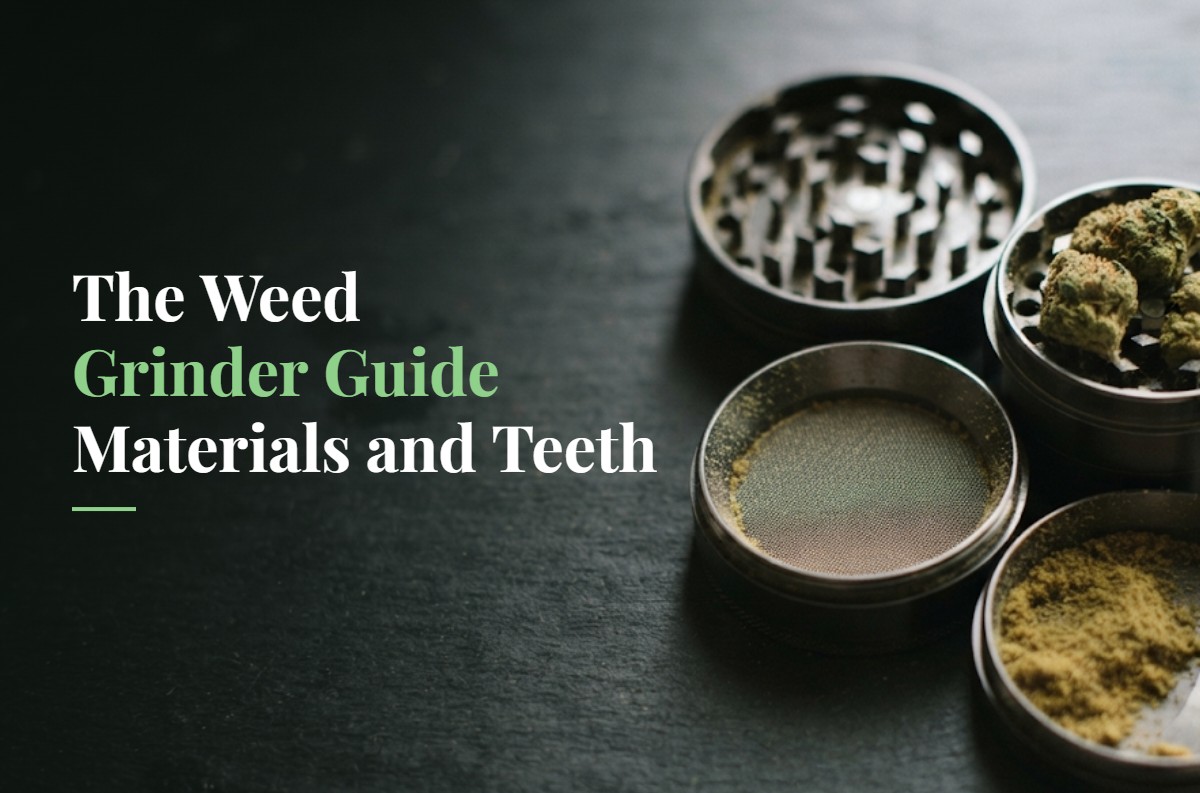
Quick answer: A weed grinder is a hand tool with interlocking teeth that shreds flower into even pieces. Two piece models hold nothing back. Three piece models drop the flower into a chamber. Four piece models add a screen and a kief cup. Material, tooth sharpness and alignment matter more than piece count.
What does a weed grinder actually do?
A grinder tears flower into similar-sized pieces so it burns or vaporizes evenly. Two plates of teeth rotate against each other. Gravity and the teeth do the work.
That evenness is the whole point. Uneven flower gives you canoeing joints and scorched bowls. Even flower gives you a predictable burn.
Grinders also keep resin off your hands. A sticky nug leaves a lot of itself on your fingers. The teeth move it along instead.
Weed grinder guide at a glance
Start with the piece count, because it decides almost everything else about the tool.
| Type | Pieces | What you get | Best for |
|---|---|---|---|
| Two piece | 2 | Lid and a single toothed bowl, no chamber | Pocket carry, packing bowls, small amounts |
| Three piece | 3 | Ground flower drops through holes into a chamber | Grinding more than one session at a time |
| Four piece | 4 | Chamber plus a mesh screen and a kief cup | People who will actually collect and use kief |
| Electric or automatic | Varies | A motor with blades or a ball and chain | Large volumes and limited grip strength |
| Toothless mill | 2 to 3 | Flower is pushed through a plate, not torn | Keeping resin glands intact |
Two piece grinders are the most honest tool on that list. Nothing is hidden from you, and there is less to clean.
How to use a weed grinder
Load the outer ring, never the middle. The center post is a pivot, not a shelf, and bud sitting on it just spins.
Break the nug into three or four pieces first. Set them between the teeth around the edge. Do not pack it full.
Put the lid on and rock it a quarter turn each way. That starts the cut without straining anything. Then make four to six full turns.
If the lid goes stiff, back it off and rock again. Forcing a jammed grinder is how teeth get bent out of line. A misaligned grinder never grinds evenly again.
Tap the body on the counter before you open it. That shakes the last pieces through the holes. Our guide to rolling a joint picks up from there.
How fine should you grind your weed?
Medium is right for most people, and the research explains why. Finer is stronger per puff but shorter overall.
Tim Sun, Hart Plommer, Sajni Shah and Markus Roggen at Delic Labs in Vancouver tested this directly. Their results appeared in Cannabis Science and Technology in April 2023. They built 18 joints at three grind sizes and smoked them on a machine.
| Grind size | THC per puff, average | Puffs per THC joint | Total THC delivered |
|---|---|---|---|
| 1 mm | 0.67 mg | About 28 | 16 to 19 mg |
| 3 mm | 0.31 mg | 52 to 54 | 16 to 19 mg |
| 5 mm | 0.51 mg | 52 to 54 | About 28 mg |
Read the middle column. The fine grind hit hardest per puff and ran out in roughly half the puffs. The coarse grind delivered the most THC overall.
The same team found that only 34 to 59 percent of the THC in a joint reached the smoker. The rest burned off or stayed in the roach. That is worth knowing before you chase perfect grind size.
Dry herb vaporizers are the exception. There, an even fine grind matters most, because the air has to pass through the whole load.
Why a four piece grinder is not always the right answer
Most guides push you straight to four pieces. We do not, and here is the trade-off they skip.
A kief screen pulls resin glands out of the flower you are about to smoke. That potency goes into the bottom cup. If you never use the cup, you have simply made every bowl slightly weaker.
Four piece grinders are also taller, harder to pocket and have twice the surfaces to clean. Our Cannabis Guides hear the same thing from customers every season. Months later there is a thin dusty layer in the kief cup and no plan for it.
There is a second reason to think twice. Grinding ahead costs you terpenes.
Researchers at the Technion-Israel Institute of Technology published a storage study in Frontiers in Plant Science in 2020. Lihi Milay, Paula Berman and colleagues found lower terpenoid concentrations in every ground sample compared with the matching whole flower. Ground material was also more prone to oxidation.
So grind what you are about to use.
What a kief catcher actually collects
A kief screen collects broken glandular trichome heads mixed with fine plant dust. It is not pure resin, and it never has been.
Those glands have been measured. Zamir Punja, Darren Sutton and Tommy Kim at Simon Fraser University published head diameters in the Journal of Cannabis Research in 2023. Stalked glandular heads ran 40 to 110 microns across, with a mean of 90 microns in one cultivar and 75 in another.
Smaller bulbous trichomes measured 15 to 30 microns. A screen that passes a 40 micron gland also passes a lot of shredded leaf. That is why kief is tan rather than white.
Here is a gap worth naming. Almost no grinder maker publishes the mesh size of its screen. Leafly's grinder roundup lists materials and prices for every pick and no micron figures at all.
That means you cannot shop by screen spec. You can only judge it after a few weeks of use. Our explainer on kief covers what to do with it, and our piece on rosin covers pressing it.
Grinder materials compared
Anodized aluminum is the default for good reason, and plastic is the one to avoid.
| Material | What it does well | What to watch for |
|---|---|---|
| Anodized aluminum | Light, sharp teeth, hard surface, most common | Unanodized aluminum can leave gray dust on the flower |
| Stainless steel | Easiest to clean, teeth stay sharp longest | Heaviest and usually the priciest |
| Wood body, metal teeth | Quiet, good looking, warm in the hand | Wood soaks up resin and smell, and cannot be soaked clean |
| Acrylic or plastic | Cheapest, you can see the load | Teeth dull then snap, and static pulls resin to the walls |
| Ceramic coated | Less sticking, slick to empty | A chipped coating cannot be repaired |
Anodizing is the detail people miss. It is a hardened surface layer, not paint. A grinder described only as "aluminum" may be neither anodized nor food safe.
Teeth patterns, and which ones matter
Sharpness and alignment beat tooth shape every time. Shape is a secondary choice.
Diamond-cut teeth are the common pattern. They have four-sided points and cut quickly into a fluffy grind. They also chew harder, which breaks more resin glands loose.
Pin or peg teeth are cylindrical. They work more slowly and treat the flower gently. They also jam more easily on damp bud.
Angled or ramped teeth pull material inward as you turn. That reduces the stiff first quarter turn. Toothless mills skip the tearing entirely and push flower through a plate instead.
Tooth count is a marketing number. A grinder with 49 dull teeth loses to one with 30 sharp ones.
Is an electric weed grinder worth it?
For most people, no. For two groups, yes.
An electric weed grinder earns its place if you have limited grip or hand strength. It also earns it if you prepare large amounts at once, for example before a long week of rolling.
The costs are real. Blades coat with resin faster than teeth do. Many models have no kief screen. You are adding a battery and a motor to a tool that otherwise never fails.
Grind consistency is the bigger issue. A spinning blade cuts whatever is nearest it, so you often get dust at the bottom and chunks at the top. Hand grinders push everything through the same gap.
Automatic weed grinder vs a hand grinder
An automatic weed grinder adds dispensing, which is the only feature a hand grinder cannot copy. That is the real difference.
Automatic models grind and then push the flower out of a spout, usually into a cone or a bowl. If you roll a lot, that saves real time.
Everything else favors the hand grinder. It is quieter, cheaper, easier to clean and impossible to run flat. It also lets you feel when the grind is done, which no button does.
How much is a weed grinder, and where can you buy one?
Leafly's grinder roundup lists picks from 29.99 to 89.95 dollars. That range covers most of what you will see on a shelf.
Below it, you are usually looking at acrylic or plain aluminum. Above it, you are paying for stainless steel, a motor or a name.
In Washington, you can buy a grinder at the same counter as your flower. WAC 314-55-079(1) lets licensed retailers sell cannabis paraphernalia along with cannabis. You can see what flower we have on the Redmond menu or the West Seattle menu.
One Washington limit catches people out. WAC 314-55-079(5) prohibits internet sales and delivery by licensed retailers. You cannot order a grinder from us online and have it shipped.
Best weed grinder: what we tell people at the counter
The best grinder for weed is the one that matches how you consume, not the one with the most parts.
Bowl and bong smokers do well with a two piece. You grind a small amount and pack it immediately. Nothing is lost to a chamber you forgot about.
Joint rollers want a three or four piece in anodized aluminum, run to a medium grind. Dry herb vape users should prioritize even output over everything else.
If you only own one grinder, we point most people at a 2.5 inch anodized aluminum three piece. It grinds a quarter ounce without a refill and cleans up in two minutes.
Frequently asked questions
How do you clean a weed grinder?
Freeze it for 30 minutes, tap the resin loose, then scrub the teeth with a dry brush. For a deeper clean, metal grinders can be taken apart and soaked in isopropyl alcohol. Wood and plastic should not be soaked. Our full walkthrough covers the soak times, the drying step and the mistake that ruins painted bodies.
How do you use a grinder for weed?
Break the bud into three or four pieces and set them in the outer ring of teeth, never over the center post. Put the lid on and rock it a quarter turn each way to start the cut. Then make four to six full turns. If it goes stiff, back it off rather than forcing it, because forcing bends the teeth out of alignment.
How much is a weed grinder?
Leafly's grinder roundup lists picks from 29.99 to 89.95 dollars, which is a fair picture of the mid market. Below that range you are usually buying acrylic or plain aluminum. Above it you are paying for stainless steel, a motor or a brand name. Ask a Cannabis Guide what we have in stock, since paraphernalia pricing changes with each order.
Where can you buy a weed grinder?
In Washington you can buy one at a licensed cannabis retailer. WAC 314-55-079(1) lets retailers sell cannabis paraphernalia alongside flower and concentrates. Smoke shops and general retailers sell them too. What you cannot do is order one from us online, because WAC 314-55-079(5) prohibits internet sales and delivery by licensed retailers.
How do you grind weed without a grinder?
Scissors inside a shot glass is the method that loses the least resin, and your fingers are the method that loses the most. A few household options sit between them. We ranked seven of them by how much resin ends up on the tool instead of in your joint, with the drying step most guides skip.
Does a kief catcher actually make the weed weaker?
Slightly, and that is the honest trade-off nobody selling grinders mentions. A kief screen pulls resin glands out of the flower you are about to smoke and saves them for later. You are moving potency, not creating it. If you never use what collects in the bottom cup, a four piece grinder is just quietly costing you a little strength per bowl.
Bring your grinder question to the counter
We keep paraphernalia behind the same counter as the flower, so you can compare a two piece and a four piece in your hand before you decide. Tell a Cannabis Guide how you smoke and we will point you at the right one.
Find us at 16390 Cleveland St in Redmond or 4822 California Ave SW in West Seattle. Both stores serve adults 21 and over from 8am to midnight under WAC 314-55-147. If your grinder needs attention first, start with our grinder cleaning guide.
Origins Cannabis is a licensed Washington retailer serving adults 21 and over in Redmond and West Seattle. Nothing here is medical advice. If you are using cannabis for a health reason, talk to a healthcare provider who knows your history.