
As someone who’s worked in the cannabis industry since 2002, I’ve seen just about every side of it. I’ve worked deep in the legacy market, watched cannabis evolve from the underground to the medical and adult-use markets, and spent years helping customers navigate dispensary shelves.
One thing has stayed the same through every era of cannabis: consumers are curious.
Whether you’re buying your very first eighth or you’ve been consuming cannabis for years, the questions are always the same.
What strain is this? Where was it grown? Why is this one more expensive? Is higher THC always better? What’s actually in this product?
Cannabis is an incredibly complex plant. Hundreds of naturally occurring compounds work together to create its aroma, flavor, and effects. That’s also why two products with nearly identical THC percentages can provide completely different experiences.
Fortunately, the legal cannabis market gives consumers something the legacy market never could: transparency.
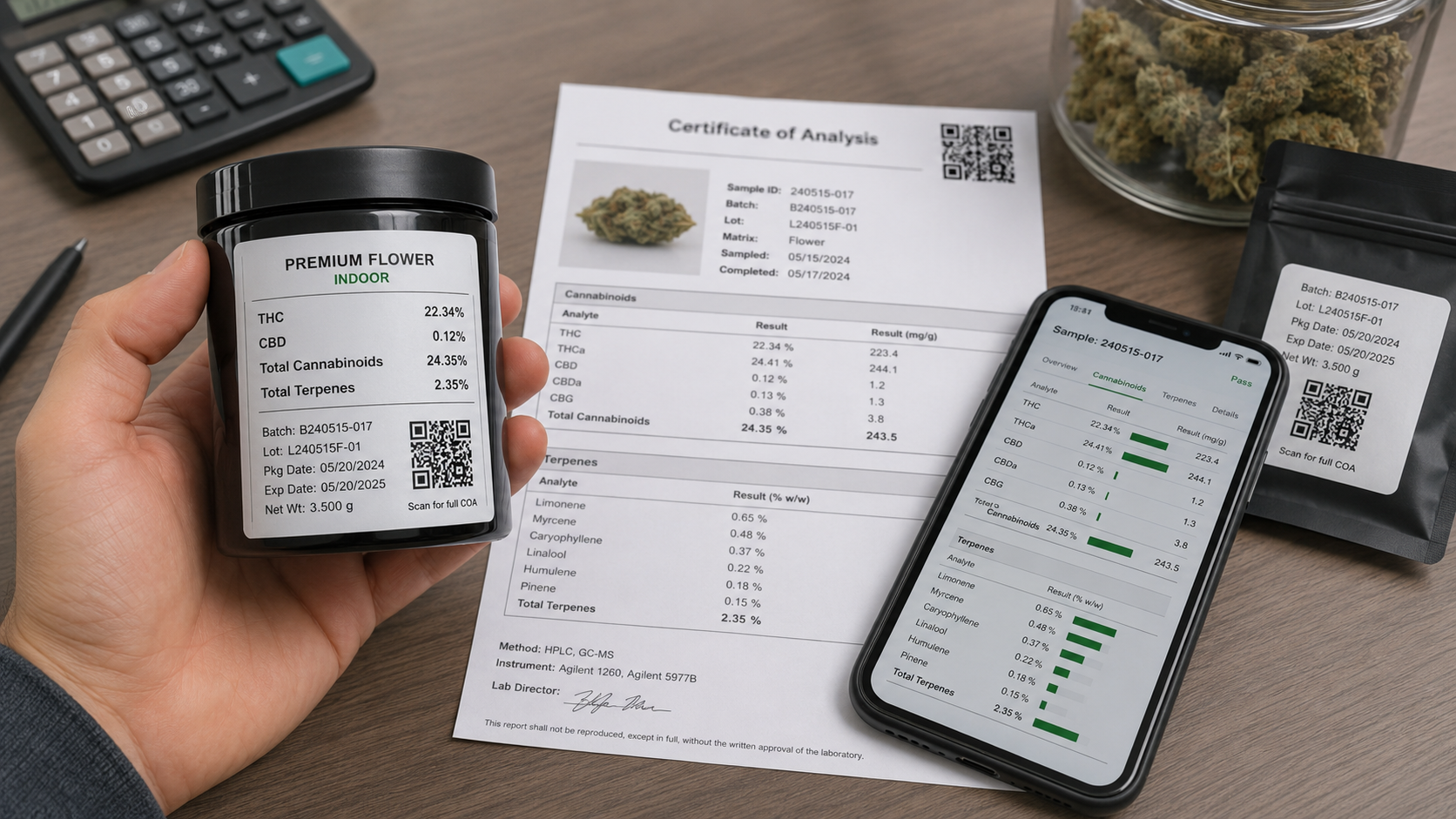
If you’ve ever looked closely at a cannabis package, you’ve probably noticed a batch number, testing information, or even a QR code. Behind those details is something called a Certificate of Analysis, or COA.
A Certificate of Analysis (COA) is a laboratory report that verifies the potency, cannabinoid profile, terpene profile (when tested), and safety of a cannabis product before it can legally be sold.
Think of the package label as the movie trailer - The COA is the full feature film.
While the label gives you the highlights, the COA shows you what the laboratory actually found after testing that specific batch of cannabis.
Real Life
Imagine you’re deciding between two eighths.
One tests at 31% THC.
The other comes in at 27% THC, yet it’s a little more expensive.
Why?
Here’s the thing: THC is only part of the story..
The Certificate of Analysis tells a much bigger story.
What should you actually look for?
Lot Number
Every batch of legal cannabis is assigned a lot or batch number before it’s tested. That number allows the laboratory results to be matched to the exact batch you’re buying. If there’s ever a recall or quality issue, regulators and producers can trace where that cannabis came from and where it went.
Cannabinoid Profile
Everyone looks at THC.
I get it.
But THC is only one cannabinoid.
A COA also shows cannabinoids like CBD, CBG, CBC, and CBN. They’re usually present in much smaller amounts, but many consumers, budtenders, and researchers believe these compounds contribute to the overall experience of a product.
You’ll also notice the difference between THCA and THC. Since flower naturally contains mostly THCA before it’s heated, the COA gives you a much more accurate picture of what’s actually in the plant than the simplified numbers printed on many retail labels.
Terpenes
THANK YOU, COA.
There simply isn’t enough room on a retail label to list every terpene and its percentage.
Terpenes are the aromatic compounds responsible for many of cannabis’s flavors and aromas, and they’re also believed to play a role in how a product feels.
You don’t need to memorize them - but it’s worth getting familiar with a few.
Myrcene is commonly associated with relaxing effects.
Limonene often brings bright citrus aromas and may feel more uplifting.
Pinene smells like - you guessed it - pine, and is often associated with alertness and focus.
If you’ve ever wondered why two strains with similar THC percentages feel completely different, terpenes are part of that conversation.
Contaminants
This is probably the least exciting section of the COA - but arguably the most important.
Before a product can legally reach a dispensary shelf, it has to pass testing for things you definitely don’t want to inhale or ingest.
That includes pesticides, heavy metals, harmful bacteria such as E. coli and Salmonella, mold, mycotoxins, and - when it comes to concentrates - residual solvents.
You’ll usually see a simple PASS next to these tests.
Honestly, that’s exactly what you want.
Most shoppers won’t spend much time here because products that fail these tests generally don’t make it onto dispensary shelves in the first place. But if you’re the kind of consumer who likes to verify everything, the COA gives you that peace of mind.
Moisture Content
This one is especially interesting for flower lovers.
Too much moisture can encourage mold.
Too little moisture leaves the flower dry, brittle, harsh, and less flavorful.
Licensed laboratories measure moisture content - and in many cases water activity - to make sure the flower falls within safe standards before it reaches retailers.
That said, your senses still matter.
Even if the flower passed testing months ago, how it’s stored afterward - both at the dispensary and once you get it home - can affect how fresh it feels when you crack open the jar.
Why the COA Matters?
The package label tells you the basics.
The COA tells you the whole story.
It verifies that the cannabinoid content matches what’s being sold, confirms the product passed required safety testing, and gives curious consumers a deeper look into what they’re actually buying.
Cannabis is one of the most fascinating plants on Earth. The more you learn about what’s actually inside it, the better equipped you’ll be to find products that fit your preferences - not just the ones with the biggest THC number.
So next time you see a QR code on your package, give it a scan. Curiosity might just make you a smarter cannabis consumer. You can always ask your RMJ fam for more deets on the products - we got you.