If you've ever looked at the back of a cannabis package and thought, "I have no idea what half of this means," you're not alone.
Most people recognize the strain name and the THC percentage, but everything else? Batch numbers, cannabinoids, THCA, producer information, QR codes… it can feel like reading another language.
As a former budtender, I answered these questions every day. Some customers wanted to know every detail. Others just wanted something they'd enjoy. Both approaches are perfectly fine.
But if you've ever wondered what all those numbers actually mean, and which ones are worth paying attention to, this guide is for you.
Why Do Cannabis Labels Exist?
Cannabis labels on legalized products have a few different functions.
One is just to let you know the name and the overall strength of what you're buying, as well as where it came from.
Secondly (and this is what a lot of consumers don't know), the legal cannabis industry has an incredibly intricate tracking system. So the batch and lot numbers you see on the labels have to do with a system called track and trace. The LCB (Washington State Liquor and Cannabis Board) would explain this to you, as a consumer, in the context of safety, and that's not wrong.
They need to be able to track each individual product from "seed to sale." That means when the product (even a highly processed one like an edible or a vape) is first generated as a PLANT, it's given a number. That number tracks it on its way from inception as a clone or seed, to a flowering plant, all the way along its route to becoming an 1/8th of flower, a vape pen, or an edible.
This is so that, in case there are any safety issues reported by consumers about the product, it can be traced back to its original source, along with the rest of the batch that has been sold to various people in various places, recalled, and the source of the problem can be identified.
Recalls don't happen very often. This is just a safety measure created by regulatory agencies that has to be in place for all consumable products (it's the same with food, beverages, cosmetics and pharmaceuticals). Another purpose of batch tracking is helping investigators identify products that have been diverted from the regulated market. The state's traceability system follows products through licensed growers, processors, distributors, and retailers. That chain of custody helps regulators investigate diversion into the illicit market, and inventory discrepancies. For example, if authorities are able to seize a load of stolen legal market goods, they can look at the label's tracking number and trace those goods back to every location where they were supposed to have been, giving them more insight into how, where from, and potentially who could have stolen or sold them under the table.
The Parts of a Cannabis Label
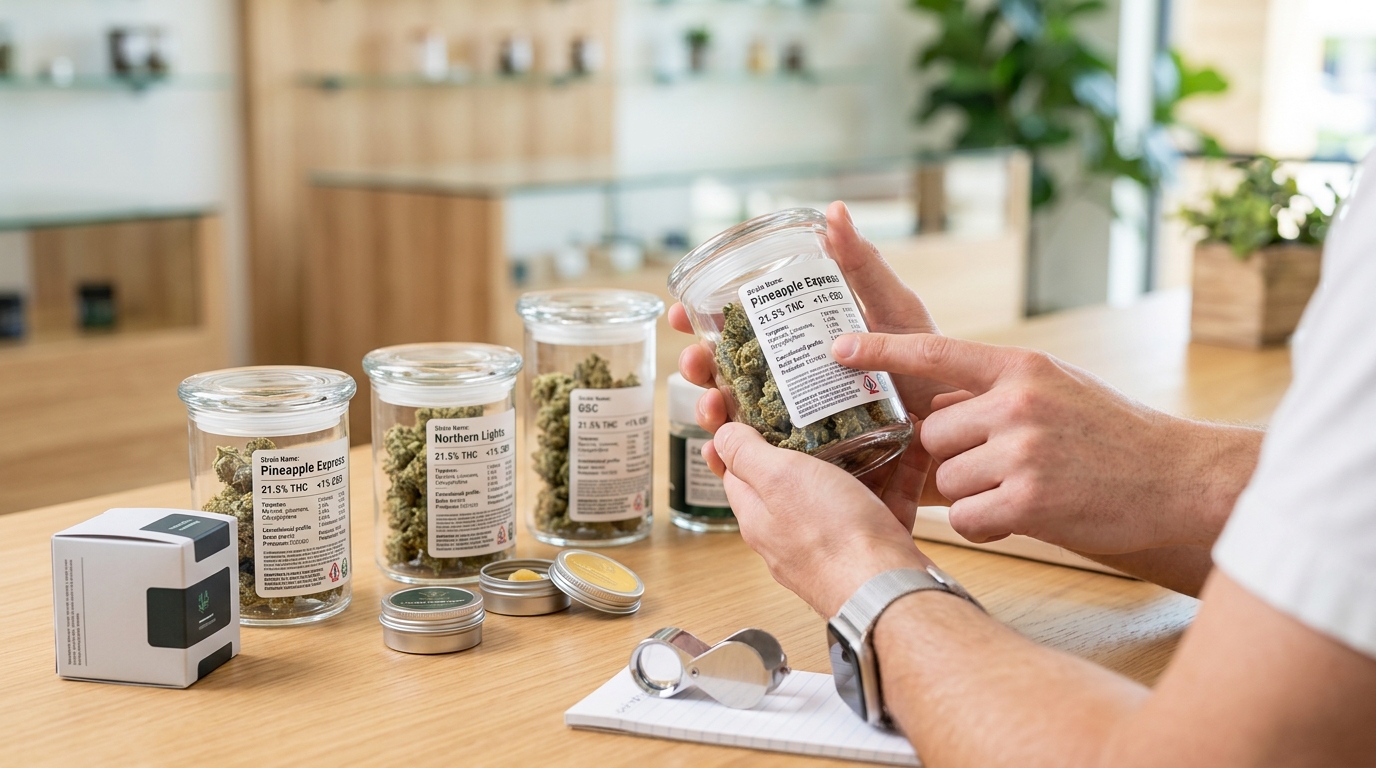
Strain/Product Name: The general product identifier. Mildly interesting to you, but more important for inventory, manifests, and state tracking systems.
Producer/Processor: This is who grew it, and also who produced it. These can be different entities. While many entities are now vertically integrated (which means growing, processing, packaging, and distribution are all under the same ownership), it hasn't always been that way. So you may see that your product was grown in a different place than it was processed.
THC %: Standard issue, the main ingredient in most cannabis products. You may also, or ONLY see THCA percentage, only on combustible products. Don't let this confuse you. THCA is the precursor to THC, and is present only in products which contain cannabis extractions that haven't been heated to a temperature where the THCA converts to THC (this process is called decarboxylation). Edibles have oils in them that are decarbed, so they don't contain THCA. But any raw, or unheated cannabis products (mostly just flower, or "live" resins or rosins) will show the THCA percentage. Once the product is heated up (combusted), the THCA turns into THC. THC percentages will always be LOWER than THCA, because THCA loses part of its molecular weight during decarboxylation, so the THC you ultimately receive is lower than the THCA percentage printed on the label.
CBD %: This will affect the "feeling" and effect of the product. CBD antagonizes THC in your body (not in a mean way, it just knocks the THC off of your receptors), so you feel less "high" the more CBD is present. There will also be more anti-inflammatory and anti-anxiety effects the higher the percentage of this goes. CBD is also (technically) non-psychoactive.
Other Cannabinoids: CBG, CBC, CBN, THCV. These minor cannabinoids are not psychoactive. But they do have an effect on the product, and on you, mostly in a medicinal context. Without getting super deep into this (that's for another article), here's what these minor cannabinoids have been observed (NOT PROVEN) to do:
- CBG: may provide a clear-headed, uplifting focus, relieving anxiety and inflammation without causing intoxication
- CBC: may have mood-boosting, anti-inflammatory, and pain-relieving effects
- CBN: primarily seems to provide deep relaxation, sedation, and pain relief
- THCV: has been associated with suppressing appetite, boosting energy, and providing a clear-headed, uplifting focus without the heavy euphoria or "couch-lock" of standard THC
Net Weight: Cannabis flower and oil weights are primarily measured, legally, by grams. Generally the smallest amount of any product you see sold in a dispensary is .5g, and the largest amount legally allowed is 28g (1oz). Don't confuse this with the weight of the cannabinoids! Net weight refers to the weight of the overall (raw cannabis) product. Once you start seeing MG (milligram) amounts on packaging, that is referring to the weight of the molecular compounds inside the product (THC, CBD, etc).
Lot/Batch Number: We went over this above. It's primarily used for tracking the product from seed to sale, for safety and loss prevention/security reasons.
Packaging Date: In general, cannabis works like food, and it's considered "expired" 1 year after its packaging date, at which point it legally has to be pulled from the shelves and destroyed. So look at the dates on your labels! Fresher is better, and you might even be able to get a discount on the item the closer it gets to expiration. (Shhh, I didn't tell you that…)
Warning Statements: These are scary but mandatory, and they're delivered in a "worst case scenario" context. They address cannabis use risks during pregnancy or breast feeding, for those under the age of 21 (technically illegal), cognitive impairment risks, the risk of using potentially hazardous equipment or machinery while under the influence, the overall dangers of smoking, and how long the effects of the product may take to onset and how long they will last. Good stuff to know.
QR Code / COA Link: This is an awesome function, and I encourage everyone to use its transparency and easy access to interesting information about the products they are looking at. Scanning this code will give you a look at the product's Certificate of Analysis (COA), which is required for every single legal cannabis product to hit the shelves. The COA will give you the information about lab results (basically what's inside the product, including terpene content), pesticide residuals, and other ingredients that may not be listed on the main label.
What I Actually Look at First
When customers first start shopping, they often go straight to the THC percentage. It's understandable, but it's only one part of the story. When I look at a label, I usually pay attention in this order:
- Producer
- Packaging date
- Terpene profile (if listed)
- Cannabinoid profile
- THC percentage
Why?
The producer is not always the same as the brand. A lot of brands are "white labelling" their products, meaning they don't produce their own flower or oil. Once you get to know who the producers are, and connect them with products that you like, you can build a sense of trust around that producer that will carry over to other brands as well.
The fresher the product, generally the better it is. Cannabinoids and organic plant products (including oil) will degrade over time, which can diminish the potency and overall quality of your experience. A lot of people look at labels for the most recent batch, and there's a reason for that. Cannabis isn't like wine. It doesn't get better with age (unless you're looking for CBN, which is basically just degraded THC).
Terpenes are the reason you get different types of psychoactive experiences from cannabis, like Indica vs Sativa, and everything in between. If there's one thing I wish more consumers paid attention to, it's terpenes. If you want energy, look for terpinolene or limonene terpenes. If you want to relax, look for humulene or myrcene terpenes. The terpenes in the product determine what the overall experience is going to "feel" like, so pay attention to them.
Minor cannabinoid content is known to increase the overall therapeutic value of your product. Minor cannabinoids can contribute to anti-inflammatory, anti-anxiety, and pain relieving effects. Some, like THCA or THCV, may provide more mental clarity or focus. Others, like CBN, may contribute sedative effects. CBG is known to relieve pain. CBD can reduce inflammation and anxiety. Look closely at these percentages, because even in small amounts, they generally affect the overall experience of the product.
THC percentage is important to understand. THC is known to be a strong pain reliever, and it's also psychoactive. THC's psychoactive effects are highly nuanced to the individual, and tolerance to them can be built. Frequent users of THC will build a tolerance to its psychoactive effects. Infrequent or new users will have a lower tolerance and may feel comfortable with lower THC percentages. Remember that the higher the THC percentage, the lower the percentage of other minor cannabinoids and terpenes can be. That means the overall experience may not be as balanced. It all depends on you, your body, and the effects you're looking for.
The Takeaway
Reading the product detail labels on your cannabis purchases can be insightful, if you want to get ahead of the game and have more awareness about what you're picking up may feel like for you. Cannabis ingredients interact with our bodies in unique and sometimes unpredictable ways. Understanding the compounds that make the plant and its derivatives what they are can be an empowering step toward tailoring your experience more finely to what you're looking to achieve. Now that you know how to read a label, you'll probably never look at the back of a package the same way again.
Want a second opinion before you buy? Our in-store Cannabis Guides do this all day. Bring your questions in, or browse what's in stock on the Redmond menu or the West Seattle menu. Next time you're holding a package, you'll know exactly what you're looking at.
Frequently Asked Questions
What's the difference between THC and THCA on a cannabis label?
THCA is the raw, unheated form of THC you'll find in flower and "live" concentrates. When you heat or smoke it, THCA converts into THC and loses a bit of its molecular weight along the way. That's why the THC you actually feel is a little lower than the THCA number on the label. Edibles are already "decarbed," so they usually show THC in milligrams instead of THCA.
What does the batch or lot number on a cannabis package mean?
It's part of Washington's seed-to-sale track-and-trace system. Every product gets tied to a number from the time it's a plant to the moment it's sold, so if there's ever a safety issue or a recall, regulators can trace it back to where it came from. It's the same idea used for food, cosmetics, and pharmaceuticals.
How do I know if my cannabis is fresh?
Check the packaging date. In Washington, cannabis is treated a lot like food and gets pulled from shelves about a year after it's packaged. Fresher is usually better, because cannabinoids and plant oils break down over time. Cannabis isn't like wine. It doesn't get better with age, and the one exception is CBN, which is basically aged THC.
What is a COA and how do I read one?
A Certificate of Analysis (COA) is the lab report that's required for every legal cannabis product. Scan the QR code on the package to pull it up. It shows the cannabinoid and terpene content and checks for pesticides and other contaminants, the kind of detail that doesn't always fit on the main label.
Should I just buy the highest THC percentage?
Not really. THC is only part of the story. Terpenes shape how a product actually feels, and minor cannabinoids add to the effect too. A very high-THC product can leave less room for those other compounds, so it may feel less balanced. It comes down to your tolerance, your body, and what you're going for.
What terpenes should I look for to feel energized or relaxed?
For energy and focus, look for terpinolene or limonene. To wind down, go for myrcene or humulene. Terpenes are the biggest reason two products with the same THC can feel totally different.
What are the warning statements on cannabis labels for?
They're mandatory, and they're written for the worst-case scenario. They cover things like use during pregnancy or breastfeeding, the 21+ legal age, impairment while driving or using machinery, and how long the effects take to kick in and how long they last. Worth a quick read, especially if you're newer to cannabis.