
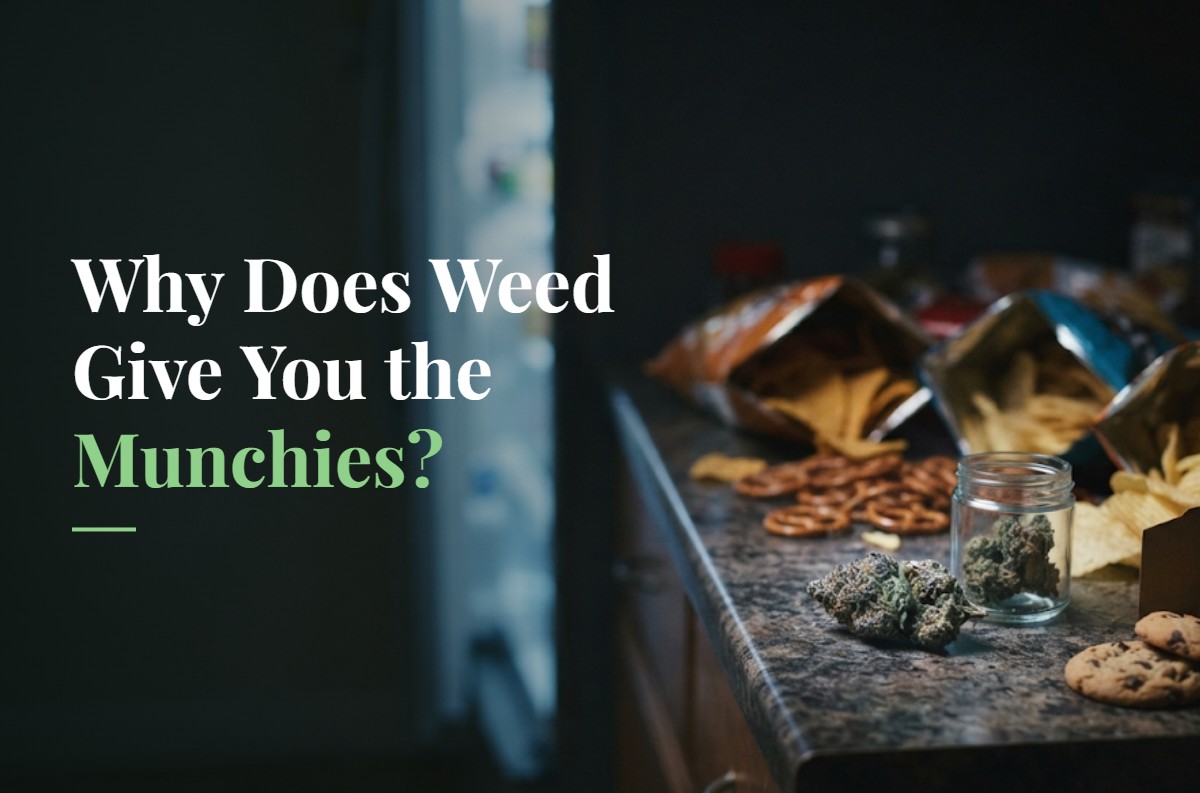
Quick answer: The munchies are a short rise in appetite and food interest after a THC dose. THC switches on CB1 receptors in brain circuits for appetite and smell. Food smells stronger and feels more rewarding. In a 2026 trial, people ate more of everything within 30 minutes.
What are the munchies?
The munchies are the burst of appetite that follows a THC dose. Scientists call it acute hyperphagia. That means eating more than usual inside a short window.
Most flower and vape users notice it 10 to 40 minutes in. Edibles push it later, sometimes well past an hour. The window is short and it closes on its own.
It is not simple hunger. You can finish a large dinner and still feel it arrive. Our guide to how long a weed high lasts covers the wider timing.
The munchies at a glance: what researchers measured
Five published studies carry most of the weight on this topic. Here is what each one actually tested.
| Study | Institution and year | What it measured | What it found |
|---|---|---|---|
| Hume, Cuttler, Baglot, Javorcikova, McLaughlin and Hill, PNAS | Washington State University and University of Calgary, 2026 | 82 adults aged 21 to 62, given 20 mg or 40 mg vaporized cannabis or placebo | More carbohydrate, fat and protein eaten in the first 30 minutes of food access |
| Koch, Horvath and colleagues, Nature | Yale School of Medicine, 2015 | CB1 receptor drugs and POMC neurons in mice | Appetite-suppressing neurons switched to releasing beta endorphin and drove feeding |
| Soria-Gomez, Marsicano and colleagues, Nature Neuroscience | Inserm and the University of Bordeaux, 2014 | CB1 receptors in the olfactory bulb of mice | Sharper smell detection and more food eaten |
| Riggs, Ellis, Grant and colleagues, Brain Research | University of California, San Diego, 2012 | Blood hormone levels after smoked cannabis | Plasma ghrelin and leptin rose, PYY fell |
| Riedel, Pertwee and colleagues, British Journal of Pharmacology | University of Aberdeen, 2009 | THCV doses in mice | Pure THCV cut food intake, a THCV-rich extract did not |
Notice the disagreement in rows one and four. We come back to that below.
Why does weed give you the munchies?
Weed gives you the munchies because THC fits the CB1 receptor, and CB1 sits on nerve cells that run appetite. Your body already makes its own cannabinoids. They help the brain decide when food is worth chasing.
THC is a blunt copy of those molecules. It reaches far more receptors at once than your own signals ever do. Three circuits respond.
The hypothalamus sets hunger and fullness. The olfactory bulb handles smell. The reward system rates how good eating will feel.
What causes the munchies in the brain?
The clearest single answer came from Yale in 2015. Marco Koch, Tamas Horvath and colleagues published it in Nature that February.
POMC neurons normally tell you to stop eating. The Yale team gave mice CB1 receptor drugs at doses that caused overeating. The POMC neurons did not go quiet. They became more active.
The switch was in what they released. CB1 activation raised hypothalamic beta endorphin without changing alpha MSH. Beta endorphin acts on opioid receptors and promotes eating.
Blocking those opioid receptors with naloxone cut the feeding response. In mice lacking the UCP2 protein, the response disappeared entirely. That is a mechanism, not a guess.
Smell matters too. The Bordeaux team, led by Giovanni Marsicano at Inserm, reported in Nature Neuroscience in 2014 that CB1 receptors in the olfactory bulb sharpen odor detection and raise food intake. Food you would normally walk past starts to register.
Why does pot give you the munchies harder some nights?
Dose, route and what food is nearby explain most of the night-to-night difference. Not strain names.
The 2026 PNAS trial is useful here. Both the 20 mg and the 40 mg doses raised food intake over placebo. Doubling the dose did not double the eating. The effect looks more like a switch than a dial.
Route changes the timing more than the size. Inhaled THC arrives in minutes. Edibles can land an hour later, which is why they catch people at bedtime.
Strain labels are weaker predictors than people assume. Our pieces on what sativa and indica labels actually tell you and what terpenes actually do explain why. The appetite research measured THC dose, not terpene profiles.
Does THC spike your hunger hormone? The research disagrees
This is the part most articles get wrong. The hormone story is not settled.
In 2012, Riggs and colleagues at the University of California, San Diego reported in Brain Research that smoked cannabis raised plasma ghrelin and leptin and lowered PYY. Ghrelin is often called the hunger hormone. That single finding became the standard explanation online.
The 2026 PNAS work points the other way. Ghrelin, leptin and insulin did not change with cannabis exposure in that study.
The same team tested where the receptors had to be. Blocking cannabinoid receptors outside the brain did not stop the overeating. Blocking them inside the brain did.
So the honest version is this. The strongest current evidence puts the munchies in your head, not your stomach. Anyone telling you THC reliably spikes your hunger hormone is quoting one 2012 pilot study and ignoring the rest.
Is THCV the anti-munchies cannabinoid?
THCV is the real counterexample, and the real disappointment. Tetrahydrocannabivarin is a minor cannabinoid with a shorter side chain than THC.
In 2009, Gernot Riedel, Roger Pertwee and colleagues at the University of Aberdeen published a mouse study in the British Journal of Pharmacology. Pure THCV reduced food intake at 3, 10 and 30 mg per kg. That is the finding every "diet weed" headline is built on.
Read the next experiment. The team also tested a botanical extract that was 57.1 percent THCV and 11.9 percent THC. At the same THCV doses, it did nothing to body weight, food intake or activity.
The authors blamed the leftover THC. A roughly 5 to 1 THCV to THC ratio was enough to cancel the effect. Real plant material is not a pure compound.
Washington labels carry THC and CBD totals under WAC 314-55-105. THCV is not a required line. If a product claims a THCV number, ask one of our Cannabis Guides to show you the lab panel behind it. Our piece on the entourage effect covers why single-compound results rarely survive the whole plant.
How to avoid the munchies when stoned
The reliable tactics change your environment and your dose, not your willpower. Here is what works and what it costs you.
| Tactic | Why it works | The trade-off |
|---|---|---|
| Eat a full meal first | You start the session already full | The effect can still arrive, just smaller |
| Portion food before you dose | Removes the decision from a brain rating food as extra rewarding | Takes five minutes of planning |
| Lower the dose | Smell and reward effects both track how much THC reaches CB1 | A milder high overall |
| Keep snacks out of the room | The olfactory findings mean smell alone can start it | You have to shop that way too |
| Have water and gum ready | Gives your mouth something to do in the first 30 minutes | Does nothing for real hunger |
| Brush your teeth after dosing | A strong, clean taste breaks the food loop for many people | Works for some people and not others |
Dose is the biggest lever on that list. Microdosing THC is the structured version of pulling it.
How to stop the munchies once they have started
Ride out the first half hour with one portioned thing, then leave the kitchen. The PNAS trial found the jump concentrated in the first 30 minutes of food access.
Drink a full glass of water before you decide you are hungry. Then eat the thing you already portioned. Standing up and changing rooms breaks the loop more often than arguing with yourself.
If you went too far on dose, eating is rarely the problem you need to solve. Our guides to greening out and the weed hangover cover that case.
How to prevent munchies before you consume
Plan the food before you plan the session. That is the whole trick.
Decide what you will eat and plate it while you are sober. Put the rest away in the kitchen, with the door shut. The Bordeaux smell findings are the reason distance beats discipline.
Pick your timing too. If you dose flower at 7pm, the window lands during the evening. If you take an edible at 10pm, it often lands at midnight with a full cupboard nearby.
Who should skip all of this advice
Some people want the appetite effect, and this page is not aimed at them. If you are cooking with cannabis for that reason, our cannabutter recipes are a better read.
We also want to be plain about limits. We are a retailer, not a clinic. If you are tracking your eating for a health reason, talk to a healthcare provider before you change anything.
Frequently asked questions
What causes the munchies?
THC binding to CB1 receptors in the brain causes the munchies. Three circuits matter most. The hypothalamus sets appetite, the olfactory bulb handles smell, and the reward system decides what feels worth the effort. In the 2026 PNAS trial, blocking CB1 receptors in the brain stopped the extra eating in rats. Blocking the same receptors outside the brain did not.
How do you avoid munchies with edibles?
Start at a low dose and eat a real meal first. Washington caps an edible serving at 10 mg of THC and a package at 100 mg under WAC 314-55-095. A single serving is a sane starting point. Edibles also take longer to arrive, so the appetite window often lands late in the evening. Dose earlier if you want to be asleep before it peaks.
What to do to curb the munchies late at night?
Drink a full glass of water, then eat one portioned thing and leave the kitchen. The Washington State University trial found the biggest jump in the first 30 minutes of food access. If you ride out that window with something measured, the pull usually fades. Keeping snack food out of the room you are sitting in works better than willpower.
How do I prevent munchies before I consume?
Portion your food before you dose, not after. Pre-plating removes the decision from a brain that is currently rating food as more rewarding than usual. Eating a protein-heavy meal first also helps, because you start the session full. Lowering your dose is the single biggest lever, since smell and reward effects both scale with how much THC reaches your receptors.
Does CBD stop the munchies?
There is no good evidence that CBD stops the munchies. In the 2009 University of Aberdeen mouse study, CBD on its own had no significant effect on food intake. It only shifted results when paired with a THCV-rich extract, and even then the food intake change was a trend at P equals 0.07. Treat CBD as unproven here rather than as a fix.
Do the munchies fade as tolerance builds?
Many regular users tell us the effect gets milder, and that fits how CB1 receptors adapt to steady THC exposure. We have not seen a clean human study that measures it, so treat it as a pattern rather than a fact. The 2026 PNAS trial used experienced users and still found a clear effect. Tolerance reduces the munchies for some people, not all.
Come talk to a Cannabis Guide
If you want the appetite effect dialed down, bring your dose question to the counter. We will walk you through serving sizes and timing on the products you already like.
Find us at 4822 California Ave SW in West Seattle or 16390 Cleveland St in Redmond. Both stores are open to adults 21 and over, 8am to midnight, under WAC 314-55-147. There is no online ordering or delivery in Washington, under WAC 314-55-079, so we will see you in person.
Origins Cannabis is a licensed Washington retailer serving adults 21 and over in Redmond and West Seattle. Nothing here is medical advice. If you are using cannabis for a health reason, talk to a healthcare provider who knows your history.