
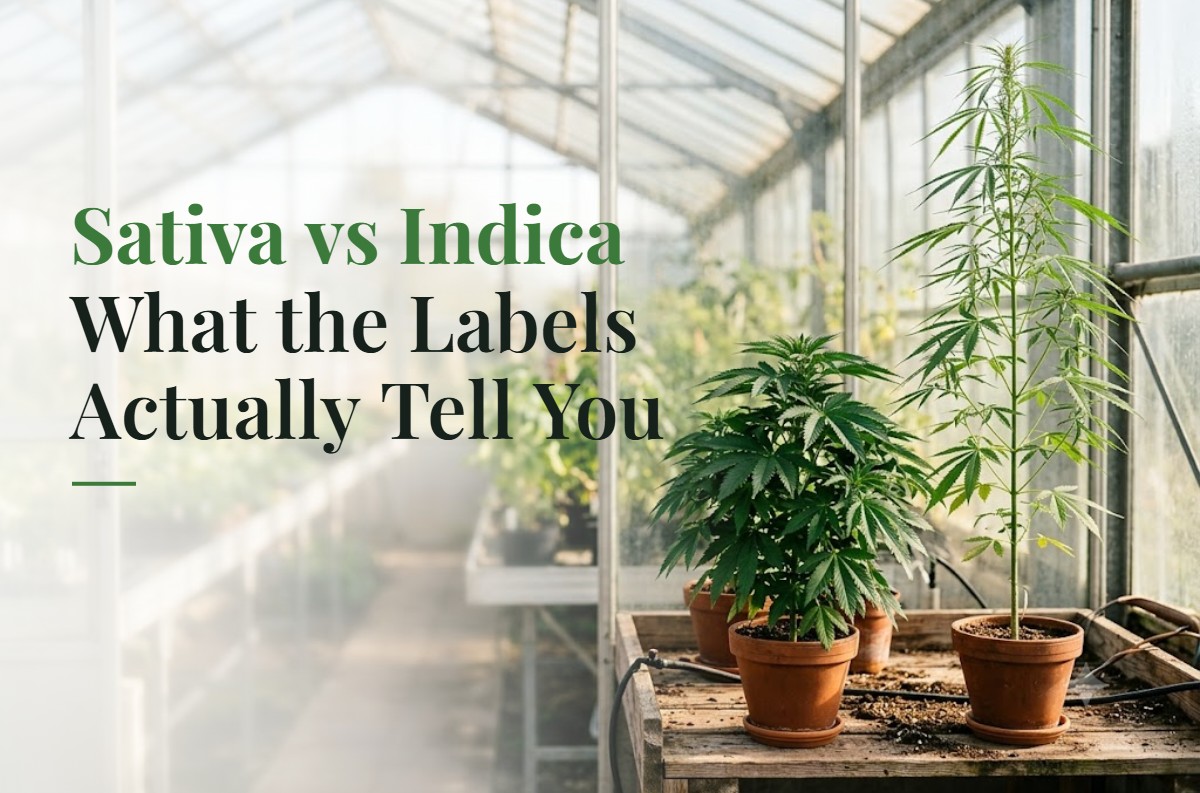
Quick answer: Sativa and indica began as botanical names, Cannabis sativa from Carl Linnaeus in 1753 and Cannabis indica from Jean-Baptiste Lamarck in 1785, describing plant shape and origin rather than how the plant makes anyone feel. A 2021 Nature Plants study found sativa-labeled and indica-labeled cannabis genetically indistinct across the genome. The labels persist because they are quick counter shorthand, not because they predict effects.
Both words are still printed on our menu. We will get to why.
Where did the words sativa and indica come from?
Two European botanists, thirty-two years apart, describing two different plants. Carl Linnaeus published Cannabis sativa in Species Plantarum in 1753. Sativa is Latin for sown or cultivated, and his plant was the tall European fiber hemp farmed for rope, sailcloth and seed oil.
In 1785, Jean-Baptiste Lamarck described Cannabis indica in the Encyclopédie méthodique, working from Indian material that was smaller, denser, more branched, and carried a reputation for intoxication that European field hemp did not.
That is the entire origin of the split. One man was looking at a fiber crop, the other at an imported drug plant, and neither of them was trying to tell you what your Tuesday evening would feel like. The taxonomic argument that followed is still unsettled: separate species, subspecies, or one variable species with regional forms.
Do the labels on a dispensary menu match the botany?
They do not, and in the most common case they run close to backwards. The plants the industry calls indica, short and broad-leafleted with a fast flowering time, trace largely to Afghanistan and the Hindu Kush, which botanists usually describe as broad-leaf drug types. Lamarck's Cannabis indica came from India and had narrow leaflets. John McPartland, writing in Cannabis and Cannabinoid Research in 2018, has documented at length how the popular use of these two words conflicts with the scientific names they were borrowed from.
So the vernacular sativa of a Washington menu and the Cannabis sativa of a herbarium sheet are two separate ideas that collided in the 1970s underground seed trade and never got untangled.
None of this makes the shelf worse. It just means the word on the jar is a piece of trade vocabulary, roughly as botanically precise as calling a tomato a vegetable.
What does the research say about sativa and indica predicting effects?
The research says the labels do not carry that information. Four studies are worth knowing by name.
Ethan Russo, in a 2016 interview with Daniele Piomelli published in Cannabis and Cannabinoid Research, put it about as bluntly as a scientist can, calling the sativa and indica distinction as commonly applied "total nonsense and an exercise in futility." His argument is that morphology, the height and leaf width the labels descend from, tells you nothing about what a plant has made chemically. In a 2019 Frontiers in Plant Science paper he named the unit he thinks is useful instead, the chemovar.
Jason Sawler and colleagues, in PLOS ONE in 2015, genotyped 81 cannabis and 43 hemp samples and checked them against the ancestry those strains claimed. The correlation was moderate at best. In 6 of 17 comparisons, samples matched a differently named sample more closely than one sharing their own name.
Sophie Watts and colleagues went further in Nature Plants in 2021, genotyping 137 samples across 116,296 genetic markers alongside chemical data from 297 samples. Sativa-labeled and indica-labeled samples were genetically indistinct on a genome-wide scale. What the labels did track, loosely, was terpene content. Myrcene ran with the indica label. Bergamotene and farnesene ran with the sativa label. The labels were describing smell, not ancestry.
Michael Smith, Daniela Vergara, Nick Jikomes and coauthors ran the biggest sample of all in PLOS ONE in 2022: 89,923 commercial flower samples from six US states. Sorted by indica, hybrid and sativa, they overlapped into clouds. Sorted by terpene chemistry, they formed three real clusters: caryophyllene and limonene, myrcene and pinene, terpinolene and myrcene.
The labels are not random. They are a low-resolution proxy for aroma chemistry, dressed up as botany.
What the label claims versus what actually drives the effect
| What the label implies | What the evidence actually shows | What is doing the work instead |
|---|---|---|
| Sativa means energizing | Sativa-labeled samples are genetically indistinct from indica-labeled ones (Watts et al., 2021) | Terpene profile, often terpinolene or limonene forward |
| Indica means sedating | The label correlates with myrcene content, not with a distinct genetic lineage | Terpene profile, myrcene and some sesquiterpenes, plus dose |
| Hybrid means balanced | Almost everything on a legal shelf is a hybrid, so the word covers the whole room | Nothing. Read the panel underneath it |
| The label reflects genetics | Only a moderate correlation with claimed ancestry (Sawler et al., 2015) | Producer's selection history and the specific cutting |
| Leaf shape predicts the high | Morphology is an agronomic trait, not a chemical one | Cannabinoid ratio and terpene content |
| Higher THC means stronger | THC percentage is a poor stand-in for experience | Dose taken, delivery format, tolerance, and body chemistry |
| The strain name guarantees consistency | Names often fail to match genetics between producers | Same producer, same cultivar, recent packaged date |
What is a chemovar, and why is it better?
A chemovar is a plant described by what it contains. Ernest Small, the Canadian botanist behind most modern cannabis classification, proposed in the early 1970s that cannabis be sorted by cannabinoid ratio rather than by looks. That system is still the cleanest thing the plant has.
Type I
THC dominant, very little CBD. The overwhelming majority of what sells in Washington, and roughly 96 percent of flower in that 2022 six-state sample.
Type II
Meaningfully mixed, often near a 1:1 THC to CBD ratio. Uncommon on the shelf and worth asking about specifically, because it behaves differently from a Type I at the same THC number.
Type III
CBD dominant with low THC. This is where most hemp-derived material sits, and where a small slice of the flower market sits too.
Researchers later added a Type IV for CBG-dominant plants and a Type V for plants that make essentially no cannabinoids at all. Layer a terpene panel on top of the chemotype and you have a chemovar: a description that would actually let two people compare notes. Arno Hazekamp's work moved the industry toward that language, and Russo has been pushing the same direction for a decade.
Our breakdown of what terpenes actually do goes compound by compound, with the honest caveat that human research on terpene effects at flower doses is early and mixed.
So why are sativa and indica still on the Origins menu?
Because they are the fastest words in the building, and the whole supply chain already speaks them. Producers print them on the package. Point of sale systems sort by them. Most people walk into West Seattle already holding one of the two words, and correcting somebody's vocabulary before you know what they want is a bad way to run a counter.
There is also a regulatory detail worth knowing. Washington's labeling rules under the Washington State Liquor and Cannabis Board, at WAC 314-55-105, require a flower label to carry the producer's trade name and UBI number, the lot number, net weight, and total THC and total CBD. They do not require a terpene profile. They do not define indica or sativa. The WSLCB has no opinion on those two words. They are an industry convention, printed at the producer's discretion.
That is why our menu also sorts by experience category: Energize, Decompress, Restore, Connect, Explore, Reflect. Those categories are built from what customers report, what the terpene panel says, and what our Cannabis Guides hear back the following week. It is a softer claim than a Latin binomial, and a more honest one.
What to read on the menu instead
In rough order of usefulness.
The terpene panel
Total terpene percentage first, then the top three by name. Anything at or above 2 percent total is a genuinely aromatic jar. Under 1 percent and the aroma is mostly gone regardless of what the label says. If you have found that terpinolene-forward flower suits your afternoons, that is a repeatable fact about you, and it will hold across strain names. Classic Haze-family genetics tend to run that way, as does a good Maui Wowie.
The cannabinoid ratio
Not the THC number on its own. The ratio. A 22 percent Type I and a 12 percent Type II are different products, and the second one is not simply a weaker version of the first.
The dose and the format
Route changes the experience more than any label does. Inhaled cannabis is felt within minutes and tapers over a couple of hours. Edibles usually take 30 to 120 minutes to arrive and last considerably longer, which is why a 5mg edible and one inhale are not interchangeable. Concentrated products, including RSO, need their own dosing conversation entirely.
The producer and the packaged date
Consistency lives with the grower, not with the name. A farm that runs the same cutting every year is more predictable than a name that six producers all use. Check the packaged date while you are there. Terpenes leave.
Your own record
Two lines in your phone after each purchase: producer, cultivar, top terpenes, dose, what happened. Three months of that beats every category header on every menu in the state. It is also the only dataset that is about you specifically.
How this plays out at the counter
Most of these conversations start the same way. Somebody asks for a sativa, and the useful next question is what they want the afternoon to look like. Working outside, working through a to-do list, sitting through a long dinner with in-laws, and getting through a Sounders match are four different asks that all arrive wearing the same word.
Once we know that, the panel does the rest. Our Cannabis Guides in Redmond and West Seattle will pull two or three jars in your price range, read the terpene numbers out loud, and tell you which producer has been consistent this quarter. If you want the evening-leaning end of the shelf, our roundup of indica-dominant cultivars is a reasonable starting list, treated as a starting list.
Bud structure comes up constantly too, since dense evening cultivars and airy daytime ones look nothing alike in the jar. Our piece on colas, buds and nugs covers what structure tells you. For the deeper history behind these genetics, start with landrace strains.
Frequently asked questions
Is sativa really more energizing than indica?
Not reliably. The pattern shows up in customer reports, but it tracks the chemistry of individual batches rather than the label. Watts and colleagues found in Nature Plants in 2021 that sativa-labeled and indica-labeled samples were genetically indistinct across the genome, with the labels lining up loosely with terpene content instead. Two jars both marked sativa can behave very differently.
What does indica actually mean on a Washington menu?
In practice it is a producer's shorthand for something they expect people to use in the evening, usually myrcene-heavy and grown from short, broad-leafleted, fast-finishing stock. It is not a regulated term. Washington's rules under WAC 314-55-105 require THC and CBD figures on a flower label and never define indica or sativa at all.
What is a cannabis chemovar?
A chemovar is a chemical variety, meaning a plant described by what it contains rather than by its name or its shape. Ernest Small proposed sorting cannabis into Type I, Type II and Type III by THC to CBD ratio in the early 1970s, and researchers including Arno Hazekamp and Ethan Russo have argued for extending that to full cannabinoid and terpene profiles.
If the labels are inaccurate, why do dispensaries still use them?
Because they are fast, and because the whole supply chain already speaks them. Producers print them, point of sale systems sort by them, and most shoppers arrive already using the words. Dropping them without offering a replacement would make the menu harder to use, not more honest. We keep them and then talk about the terpene panel underneath.
Does leaf shape tell you anything about the effect?
No. Leaf width, plant height and branching are agronomic traits that mattered to farmers choosing what would finish in their climate. Ethan Russo, interviewed by Daniele Piomelli in Cannabis and Cannabinoid Research in 2016, called the popular sativa and indica distinction total nonsense and pointed out that you cannot read a plant's chemistry off its silhouette.
Is a hybrid label any more accurate?
Hybrid is the most honest of the three words and the least useful. Nearly every cultivar in a licensed Washington store is a hybrid by any reasonable definition, so the word describes the entire shelf. When a menu says hybrid it usually means the producer did not want to commit, which is fine, but it leaves you nothing to act on.
What should I ask for instead of sativa or indica?
Name the effect you want, the time of day, and something that worked before. A Cannabis Guide can work backward from that to a terpene profile and a dose. Asking for the terpene panel and the packaged date on two or three jars in your price range tells you more than the category header did, and it takes about a minute.
Where that leaves you
Keep using the words. They start a conversation, and everyone in the building knows what you mean. Just do not ask them to carry more weight than two eighteenth-century botanists intended. A jar marked sativa is making a promise nothing on the label backs up.
The terpene panel does, at least partly, and it costs nothing to look. Scan the West Seattle flower menu or the Redmond flower menu before you come in, then ask a Guide to read you the numbers.
Origins Cannabis is a licensed Washington retailer serving adults 21 and over in Redmond and West Seattle. Nothing here is medical advice. If you are using cannabis for a health reason, talk to a healthcare provider who knows your history.