
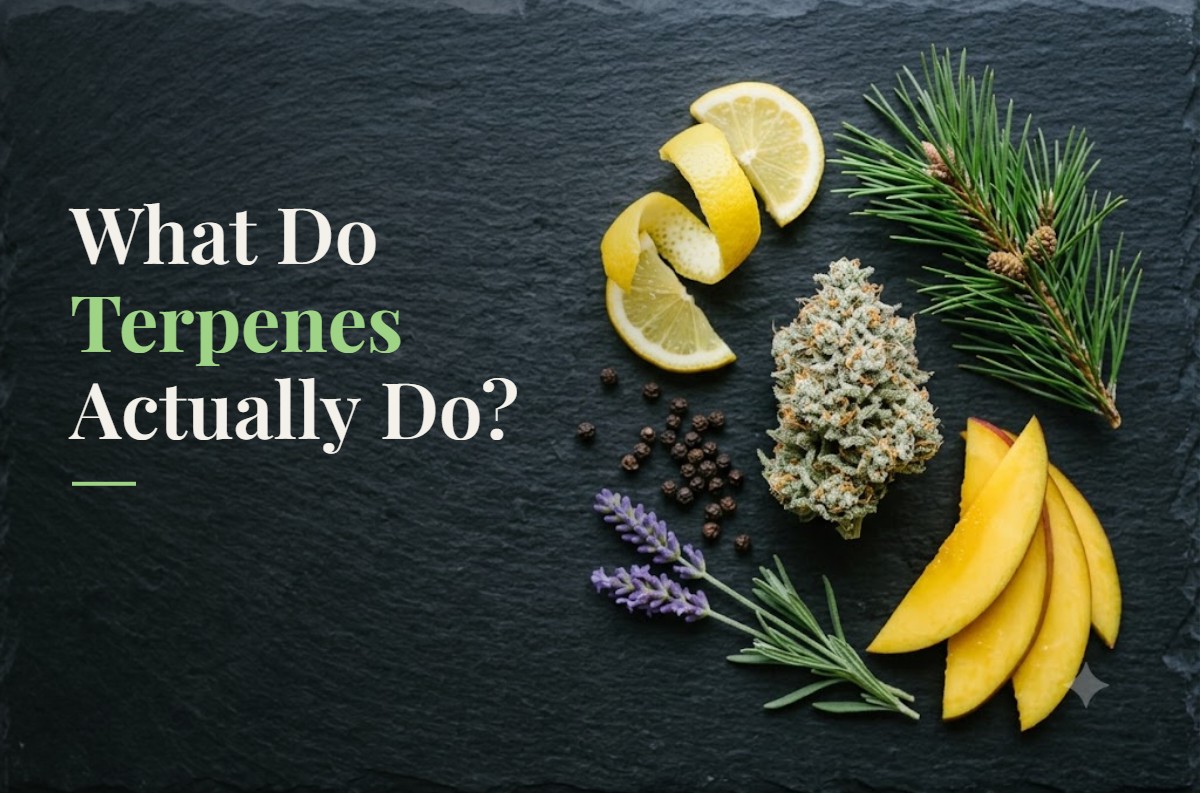
Quick answer: Terpenes are aromatic oils that cannabis makes in its glandular trichomes, and what they reliably do is give a cultivar its smell and taste. Whether they steer your high is unsettled. Ethan Russo proposed cannabis synergy in the British Journal of Pharmacology in 2011, and a 2020 study led by David Finlay found no direct terpene activity at CB1 or CB2 receptors.
That is the honest version, and most terpene content online will not give it to you.
What are terpenes and where does the plant make them?
Terpenes are volatile aromatic compounds built in the glandular trichomes, the mushroom-shaped resin heads on the surface of the flower and surrounding leaf. The same glands make THC and CBD. Enzymes called terpene synthases assemble them, and a 2017 PLOS One paper by Judith Booth, Jonathan Page and Jorg Bohlmann identified the gene family responsible in Cannabis sativa.
Cannabis is not special for making them. Terpenes do signaling work across the plant kingdom, and pine resin, lemon peel and hops are the same chemistry.
Two size classes matter for reading a panel. Monoterpenes are the small light ones like myrcene, limonene and pinene, and they evaporate readily. Sesquiterpenes are heavier and stickier, like caryophyllene and humulene, and survive storage much better. That difference explains most of what happens to a jar over six months.
Trichome density varies across the plant too, which cola versus bud versus nug gets into.
What does the research actually show about terpenes and your high?
A plausible idea with thin direct support, one confirmed mechanism, and marketing that ran far ahead of both.
What Russo's 2011 paper really said
Ethan Russo published "Taming THC: potential cannabis synergy and phytocannabinoid-terpenoid entourage effects" in the British Journal of Pharmacology in 2011. It is the most cited source in every terpene article you have read, and almost nobody citing it has read it.
It is a review, not an experiment. Russo pulled together scattered pharmacology on individual terpenes and cannabinoids and argued that combinations were worth investigating. Note the word "potential" in the title. He proposed a hypothesis and did not demonstrate it. Fifteen years of dispensary copy quietly upgraded that paper from a proposal into a proof. That upgrade never happened in the literature.
What happened when researchers tested it directly
Mostly, it did not replicate. In 2020, David Finlay, Michelle Glass and colleagues published in Frontiers in Pharmacology under the blunt title "Terpenoids From Cannabis Do Not Mediate an Entourage Effect by Acting at Cannabinoid Receptors." They tested myrcene, alpha-pinene, beta-pinene, beta-caryophyllene and limonene at 10 micromolar, alone and in three mixtures, and found no support for direct interaction with CB1 or CB2. Related 2020 work found the same at TRPA1 and TRPV1.
The picture is not closed. In November 2025 an Israeli group published in Biochemical Pharmacology testing sixteen terpenes and reported weak, dose-dependent partial agonism at CB1 and CB2, reaching roughly 10 to 60 percent of THC's activation. That is cell work, not people. It moves the question rather than settling it, and nobody has run the human trial.
The one mechanism that is not in dispute
Beta-caryophyllene binds CB2. Jurg Gertsch and colleagues established this in a 2008 PNAS paper titled "Beta-caryophyllene is a dietary cannabinoid," showing it acts as a selective CB2 agonist. CB2 receptors sit mainly in immune tissue, not the brain, so this is not a compound that gets you high.
It is also in black pepper, cloves and rosemary. You have been eating a cannabinoid your whole life. Best-documented terpene mechanism in the plant, and the one with least to do with what people shop for.
Terpene reference table
| Terpene | Smells like | Also found in | Boiling point | What the evidence actually supports |
|---|---|---|---|---|
| Myrcene | Earthy, musky, ripe fruit, clove | Hops, lemongrass, thyme, bay laurel | 167 C / 333 F | The most common cannabis terpene and a strong aroma marker. Sedation claims are folklore, not trial data. |
| Limonene | Bright citrus peel, lemon, orange | Citrus rind, juniper, peppermint | 176 C / 349 F | Well established as a citrus aroma compound. Mood claims in humans are preliminary. |
| Beta-caryophyllene | Black pepper, warm spice, wood | Black pepper, cloves, rosemary, hops | See note below | The one confirmed mechanism: a selective CB2 agonist (Gertsch, PNAS, 2008). Not intoxicating. |
| Alpha-pinene | Pine needles, fresh forest, sharp | Pine, rosemary, basil, dill | 156 C / 313 F | Easy to recognize by nose. Alertness claims are not established in people. |
| Linalool | Floral, lavender, soft citrus edge | Lavender, coriander, birch, mint | 199 C / 390 F | Strong aroma signature. Calming claims come from animal and aromatherapy work. |
| Terpinolene | Fresh, apple and lilac over pine | Nutmeg, apples, cumin, tea tree, lilac | 186 C / 367 F | A reliable marker of certain sativa-leaning chemovars. Effect claims are thin. |
| Humulene | Hoppy, woody, dry earth | Hops, coriander, clove, basil | See note below | Close to caryophyllene and usually appears alongside it. Appetite claims are unsupported. |
| Ocimene | Sweet, herbal, green, slightly woody | Mint, parsley, basil, orchids | See note below | Uncommon as a dominant terpene. Mostly an aroma contributor. |
| Bisabolol | Sweet chamomile, faint honey, powdery | German chamomile, candeia tree | See note below | Widely used in skincare. Cannabis-specific effect research is absent. |
A note on boiling points, because nearly every chart online gets this wrong. The monoterpene figures above are atmospheric-pressure values. The numbers usually printed for caryophyllene (around 116 C), humulene (around 123 C), ocimene (around 100 C) and bisabolol (around 153 C) were measured under vacuum, and the charts almost never say so. That makes heavy sesquiterpenes look more volatile than light monoterpenes, which is backwards. At normal pressure they boil far higher, so anyone telling you to vape low to "target caryophyllene" is reading a mislabeled chart. Temperature still matters for how vapes and dry herb devices heat your material, since lower settings pull the light aromatics first.
Two terpene claims you should stop repeating
Both get said across our counter weekly. Both are wrong.
Eating a mango before you smoke
There is no evidence for it. The story goes that mangoes are rich in myrcene, that myrcene opens the blood-brain barrier, and that eating one beforehand intensifies the effect. Every link in that chain is weak. Published analyses of mango cultivars found myrcene absent from many varieties and in trace amounts in most others. A whole mango carries a fraction of a milligram. A gram of terpene-rich flower carries several. The math fails even if the mechanism held.
Eat the mango because mangoes are good.
Myrcene above 0.5 percent means it is an indica
This gets repeated as though it came from a study. It did not. No published research establishes a myrcene percentage that predicts sedation in people. The 0.5 figure entered circulation through industry writing and got copied until it sounded official.
The deeper problem is the category. Sedating and energizing are not properties you read off one number on a certificate of analysis, the same reason the sativa and indica labels tell you less than you think.
Myrcene is still worth reading. It tells you the jar will probably smell earthy and fruity rather than sharp and citrusy. Real and useful. Not a prediction about your evening.
How do you read a Washington terpene panel?
Read the top three by percentage and ignore the rest. Those tell you how the flower will smell and taste, and entries below about 0.1 percent are noise.
Under WAC 246-70-050, terpene analysis is not required in Washington. Pesticide, heavy metal and mycotoxin screening are. If a producer prints terpene content on the package, a third-party lab analysis has to be available for a customer to review on request. So a jar without a panel is not a bad jar, it is a farm that skipped an optional cost.
Check the date too. Those numbers describe the day the sample was tested, not what is in your jar now.
Does total terpene percentage matter?
Somewhat, as an aroma expectation, and not as a quality grade. Most flower panels we see land between roughly 1 and 3 percent total terpenes. Above 2 percent is loud in the jar and uncommon. Below 1 percent usually means a low-terpene cultivar, or flower that has already lost its volatiles.
Two jars at the same total can behave completely differently. A 1.8 percent panel dominated by terpinolene and limonene is nothing like one dominated by myrcene and humulene. Composition carries more information than the sum, and the sum is marketed by the same industry that turned THC percentage into a scoreboard. Apply the same skepticism, and pay more attention to who actually grew the flower.
How should you store cannabis to protect terpenes?
Cool, dark, airtight, and left alone. Time, heat, light and oxygen strip a jar, roughly in that order of damage in a normal household. Monoterpenes go first because they are lightest, which is why old flower smells flat and woody instead of bright and fruity. The pretty top notes are the ones that disappear.
Heat drives evaporation. Ultraviolet light breaks the molecules apart. Oxygen turns them into compounds that smell like hay. Opening a jar repeatedly does all three at once. This is the best understood part of terpene science and the part nobody acts on. You can spend fifteen extra dollars chasing a 3 percent panel and destroy half of it on a warm shelf.
- Glass with a real seal. An airtight jar beats the plastic pop-top you brought it home in, and beats a bag badly. Plastic also pulls trichomes off with static.
- A cupboard, not a windowsill. Sunlight is the fastest way to strip aroma.
- Two-way humidity control at 58 to 62 percent. Too dry and the flower sheds terpenes. Too wet and you invite mold.
- No freezer, no fridge. Cold makes trichomes brittle and frozen flower shatters. Fridges cycle temperature and humidity, worse than a stable cupboard.
- Stop opening it. Every open is an air exchange. Decant a few days' worth and leave the jar shut.
- Buy smaller, buy more often. The most effective preservation strategy is not owning eight-week-old flower.
Ground flower in a pre-roll has far more surface area exposed to air, so it fades faster than whole buds.
How our Guides use terpene panels at the counter
As an aroma forecast and a freshness check, and we say out loud that the effects part is unproven. Tell a Guide on California Ave in West Seattle or at our Redmond store on Cleveland Street that you liked something citrus-forward last time, and the panel finds the next jar better than a strain name does.
It is also how we talk about older genetics. Why a Haze cultivar smells nothing like a modern dessert cross, or why a landrace-descended line tastes as it does, shows up in the numbers. Same with Maui Wowie, where terpinolene and limonene are what the name promises.
Ask for the panel. Ask for the packaged date. If a Guide tells you a terpene will make you sleepy, they are repeating something they read, and you can push back.
Frequently asked questions
What do terpenes actually do?
Terpenes produce the aroma and flavor of cannabis, and that part is settled. The claim that they steer the character of your high remains a hypothesis. Ethan Russo proposed it in the British Journal of Pharmacology in 2011, and a 2020 study by David Finlay and colleagues tested five common terpenes and found no direct activity at CB1 or CB2 receptors.
Is the entourage effect real?
It is an open question, not a settled fact. Russo's 2011 paper proposed cannabinoid and terpene synergy as something worth testing. Direct receptor tests since have mostly failed to find the interaction. A 2025 cell study in Biochemical Pharmacology did report weak partial agonism, so the question is still moving. Anyone selling you certainty is ahead of the data.
Does eating a mango before smoking make you higher?
There is no evidence for it. The claim rests on mangoes containing myrcene, but published cultivar analyses show myrcene is absent or in trace amounts in most mango varieties. A whole mango carries a fraction of a milligram, while a gram of aromatic flower can carry several milligrams. No clinical trial has tested the idea in humans.
Does myrcene above 0.5 percent make a strain sedating?
No. That threshold circulates on menus and blogs with no published study behind it. Nobody has run the human trial that would establish a myrcene cutoff for sedation, and the figure has no traceable origin in the literature. Treat it as folklore. Myrcene is a useful aroma marker, not a sleep switch.
Does Washington require terpene testing?
No. Under WAC 246-70-050, terpene analysis is not required in Washington. If a producer prints terpene content on the label, an analysis from a certified third-party lab must be available for a consumer to review on request. Pesticide, heavy metal and mycotoxin screening are the mandatory ones. A missing panel means the farm skipped an optional test.
Do terpenes matter more than THC?
For flavor and character, yes, comfortably. For intensity, no. THC percentage is a rough guide to strength and terpenes a good guide to smell and taste. Neither predicts how a specific person responds, which is why dose and tolerance matter more than anything printed on the jar.
Terpenes are the best shopping signal available, and they signal aroma and character, not effects. That is a smaller claim than the industry makes, and the one that holds up. Use the panel to find flower you will enjoy smelling, store it so it still smells that way in a month, and treat the rest as an open question.
Have a look at the West Seattle flower menu or the Redmond flower menu, and ask a Guide for the terpene panel on anything that catches your eye.
Origins Cannabis is a licensed Washington retailer serving adults 21 and over in Redmond and West Seattle. Nothing here is medical advice. If you are considering cannabis for a health reason, talk to a healthcare provider who knows your history.