
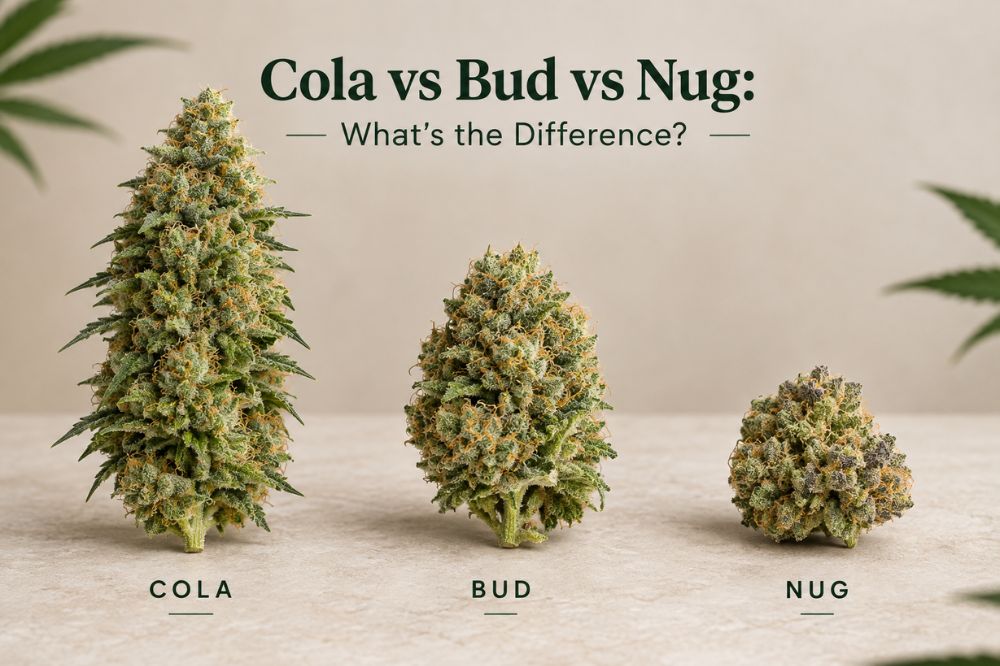
Quick answer: A cola is the entire flower cluster running along the top of a stem or branch on a living plant. A bud is one flower cluster after it has been cut and trimmed. A nug is shop slang for a bud small enough to sit in your palm. Same tissue, three scales. Cola is Spanish for tail, borrowed because a ripe top cluster hangs like one.
That is the whole distinction. The part nobody explains is why it changes what you should put in your basket.
Are a cola, a bud and a nug three separate things?
No. They are one structure at three magnifications, and the word you pick signals whether you mean a plant, a harvest or a jar.
A grower walking a flower room talks about colas: the plant is standing and the flowers are stacked along the stem. A trimmer talks about buds. You talk about nugs, because "nug" is short for nugget.
One physical difference is worth knowing. A cola has a woody stem running up the middle of it. Buds and nugs are what is left once that stem has been broken away. That is why nobody sells you an intact cola in a 3.5 gram jar: you would be paying for stalk.
Where does the word "cola" come from?
Cola is Spanish for tail, from the Latin cauda. A thick elongated cluster hanging off an arching branch does look like one. Spanish speakers in growing communities also used colita, little tail, for the flowering tip.
That account is repeated everywhere, but nobody has documented who first said it in English, or when.
The related term is the main cola, sometimes the apical cola: the dominant cluster at the very top of an untrained plant. Growers usually do not want just one. Topping and trellising exist to break that single tip into eight or twelve competing colas, because even light across a flat canopy makes more usable flower than one showpiece over a lot of shade.
Cannabis anatomy: the slang word, the botanical word, and what you actually see
Left column is what gets said at the counter, middle is what a botanist would say, right is what you are looking at.
| What we say | What it actually is | What you see in the jar |
|---|---|---|
| Cola | Inflorescence, the terminal or apical one if it's the top | Nothing, colas get broken down before packaging |
| Bud | A trimmed section of that inflorescence | The individual chunks of flower |
| Nug | Slang, short for nugget. No botanical meaning | A bud you can hold between two fingers |
| Calyx | Perigonal bract, a modified leaf | Green teardrop pods that swell and fatten as flower ripens |
| Pistil, or "the hairs" | Stigmas. Two per flower, and the pistil is the whole female organ | Rust, orange or brown threads curling out of the bract |
| Sugar leaf | Small leaves growing out of the flower itself | Short trimmed leaf tips, frosted, still attached |
| Fan leaf | The big serrated true leaf | Should not be in your jar at all |
| Trichome | Capitate-stalked glandular trichome, the resin gland | The frost. Looks like sugar, catches light |
| Larf | No botanical term. Underdeveloped lower flower | Wispy, loose, more stem than flower |
| Popcorn bud | A size, not a plant part | Thumbnail-sized nugs, usually dense enough |
| Smalls | A commercial sorting grade | A jar of uniformly small nugs at a lower price |
Two of those are worth pausing on.
Calyx is wrong and everyone uses it anyway, us included. Cannabis does not form a true calyx the way most flowering plants do. Those swelling green pods are bracts, and they carry the heaviest coverage of resin glands on the plant.
Pistil is loose too. The orange hairs are stigmas, and they carry almost no resin, so judging flower by how orange it looks is a bad habit.
Does a bigger nug mean better weed?
Not on its own, and this is the most expensive misunderstanding on a flower menu.
Bud size is largely a function of light position. Flowers at the top of the canopy get direct light and fill out. Flowers eighteen inches down, shaded by everything above them, stay small. Genetics and training feed into it too. None of those inputs is a resin measurement.
What predicts your experience is the terpene panel, the packaged date and the grower's name. A four-month-old golf ball at 0.6 percent total terps smokes worse than a three-week-old popcorn nug from a farm that cures properly.
Larf, popcorn buds and smalls are not the same thing
They get used interchangeably. They should not be.
Larf
Larf is the airy, half-formed flower from the shaded bottom and inner branches. Loose bracts, lots of stem, no density. Growers strip it during flower, a job called delarfing, so the plant stops feeding sites that will never finish.
Popcorn buds
Popcorn buds are small but properly formed, roughly thumbnail-sized, usually from the middle and lower canopy. Real flower, just not showpieces.
Smalls
Smalls is a processing grade, not a plant description. After trimming, a producer runs flower over screens or sorting tables and whatever falls below a set size is packaged separately. On a well-run line, that jar is the same cultivar, harvest date and cure as the large-nug jar next to it at a higher price.
Where does larf actually end up?
In pre-rolls, infused products and extraction, almost every time. A pre-roll gets ground before it burns, so density stops mattering the second it hits the grinder, and extraction cares about resin, not shape. If you have wondered why some flower costs so much more than other flower, a good part of the answer is sorting labor and appearance, not chemistry.
Why some flower comes in dense marbles and some in long airy spears
Bud structure follows plant architecture, which follows genetics and climate.
Broad-leaflet, cool-climate plants, the ones sold as indica, have short internode spacing, so flowers crowd together and fuse into tight, heavy, rounded nugs. Narrow-leaflet equatorial plants stretch, and longer gaps between nodes produce elongated, spear-shaped colas that feel airy in the hand even when perfectly ripe.
That difference is real, and it is close to the only honest thing the indica and sativa labels still track. It says almost nothing about effect, which we argue at length in our piece on what the sativa and indica labels actually tell you. For where those growth habits came from, start with landrace strains.
A loose, stretchy cola is not badly grown. It may just be doing what its genetics do.
What we tell people who ask for "the big nugs"
We ask what they are doing with it.
If you want flower that looks good in the jar on your shelf, buy the top-shelf eighth. If you are grinding it for joints anyway, smalls are close to free money: same batch, lower price per gram, less stem to pick out, and a more even grind because the pieces already match in size.
Our Cannabis Guides at Redmond and West Seattle can usually tell you whether a smalls jar came off the same run as the full-size version. Sometimes it did. Sometimes it is a different lot, and we say so.
Ask the packaged date. Ask the total terpene percentage. Then ignore the size.
Frequently asked questions
What is the difference between a cola, a bud and a nug?
They describe the same tissue at three scales. A cola is the full flower cluster running along a stem or branch, still on the plant. A bud is one cluster after it has been cut and trimmed. A nug is shop slang for a bud small enough to hold in your hand. Nobody sells a whole cola in a 3.5 gram jar.
Are popcorn buds and smalls the same thing?
Close, but not identical. Popcorn buds describes a size, roughly thumbnail-sized flower from the lower and inner canopy. Smalls is a commercial sorting grade, meaning flower that fell through a set screen size after trimming. Most smalls are popcorn buds, and on a good producer's line they are the same cultivar, harvest and cure as the premium jar.
Are smalls lower quality than regular flower?
Not automatically. Bud size is mostly a function of where a flower sat relative to the light, not of how much resin it carries. Smalls from a careful producer are the same genetics and the same batch, sorted by size. Check the packaged date and the terpene number instead. Those tell you far more than the diameter of the nug does.
What is larf?
Larf is the wispy, underdeveloped flower from the shaded bottom and interior of the plant. Those sites never got enough light to fill out. Growers prune and train to reduce it. Most larf never reaches a flower jar, because it gets routed into pre-rolls, infused products or extraction, where density does not matter and resin content still does.
Why do people say calyx when they mean bract?
An old habit that got repeated until it stuck. The green teardrop pods that swell as flower ripens are perigonal bracts, modified leaves wrapping the seed site, and they carry the densest coverage of resin glands on the plant. Cannabis does not form a true calyx the way most flowering plants do. Almost every grower and budtender still says calyx, us included.
Picking flower once you know the words
Knowing a nug is a piece of a cola will not make you higher. It will stop you paying a premium for appearance you were going to grind into powder anyway.
Have a look at the West Seattle flower menu or the Redmond flower menu and sort by price per gram rather than by photo. If smalls are on there from a producer you already like, that is the easy win. If you are grinding it anyway, the pre-roll menu did the grinding for you.