
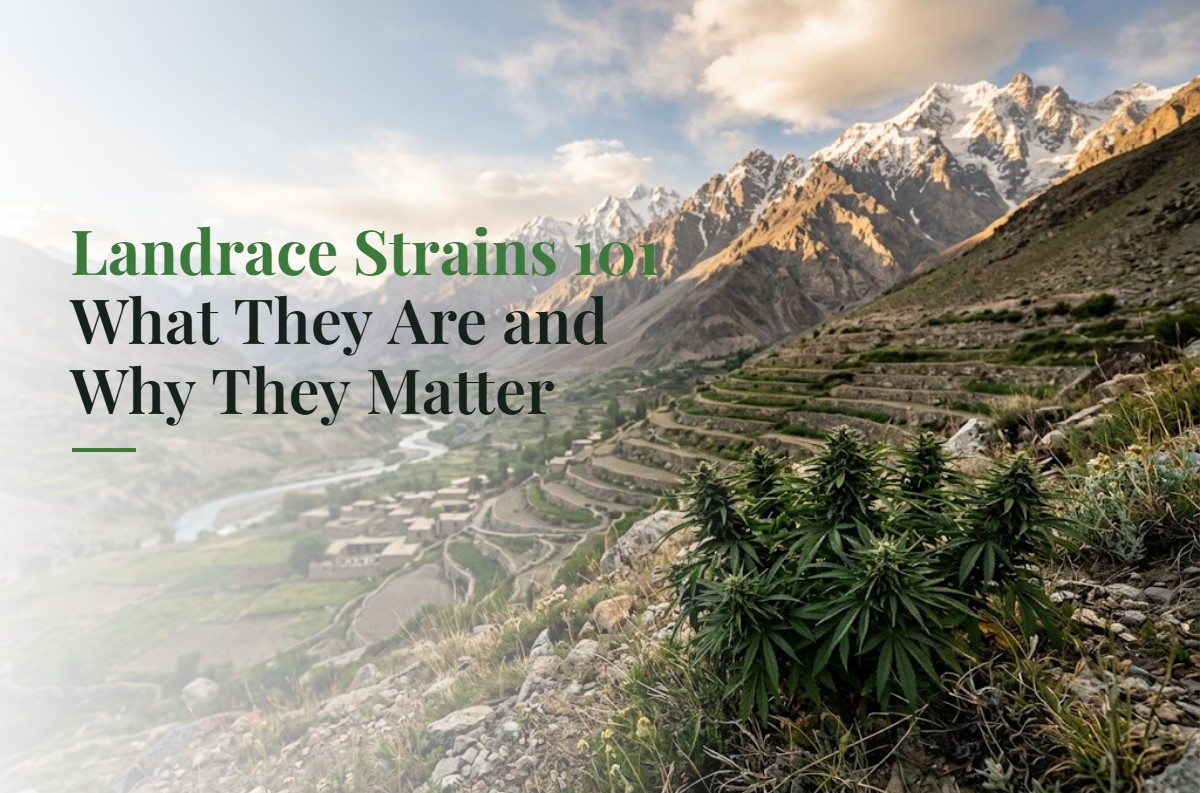
Quick answer: A landrace strain is a cannabis population that adapted to one region over generations of open pollination and local selection, with no formal breeding program behind it. Afghani in the Hindu Kush, Durban Poison around Durban, Malawi Gold in central Africa. They matter because nearly every cultivar on a Washington shelf in 2026 traces back to roughly a dozen of these populations.
That founding pool was narrow when it was assembled, and it has been narrowing ever since. That's the actual story, not the romance about pure ancient genetics.
What is a landrace strain?
It's a crop population that got its shape from a place rather than a breeder. The word is borrowed from agronomy, and the cleanest definition comes from Camacho Villa, Maxted, Scholten and Ford-Lloyd in Plant Genetic Resources in 2005: a dynamic population of a cultivated plant with historical origin, distinct identity and no formal crop improvement, usually genetically diverse, locally adapted and tied to traditional farming.
Notice what that definition does not say. Not pure. Not ancient. Not uniform.
A landrace is a population, not a variety. Plant a hundred Afghani seeds from a village in Balkh province and you get a hundred slightly different plants that all read as Afghani. That internal variation is the point, and it's the raw material a breeder needs.
The four things that have to be true
- Historical origin. Growing there long enough to have a history, not one grower's lifetime.
- Distinct identity. People nearby can tell it from the next valley's crop.
- No formal improvement. Selection happened in a field, by eye, over generations.
- Local adaptation. Day length, altitude, rainfall, pests and local use all shaped it.
Cannabis rarely satisfies all four cleanly, which is why arguments about this go in circles.
Landrace, heirloom or modern hybrid: what's the actual difference?
Timescale and who did the selecting. A landrace adapted where it originally grew. An heirloom is seed carried somewhere new, then held in a small population by growers. A modern hybrid is a deliberate cross aimed at a target.
| Landrace | Heirloom | Modern hybrid | |
|---|---|---|---|
| How it formed | Open pollination in one region | Imported seed kept isolated by a small group of growers | Deliberate crosses toward a goal |
| Rough timescale | Centuries | Decades, often one or two human generations | Years |
| Who selected it | Farmers, by eye, for local use | Growers in the new place | Breeders, for yield, potency or flavor |
| Genetic width | Wide inside the population | Narrower, founder effect | Narrow, and often one cloned plant repeated |
| Typical example | Afghani, Durban Poison | Maui Wowie, Alaskan Thunder Fuck | Gelato, Wedding Cake |
Which is why Maui Wowie sits in the heirloom column. Cannabis is not native to Hawaii. Same problem with Alaskan Thunder Fuck, assembled in the Matanuska Valley inside living memory from seed somebody carried north. Acapulco Gold is the borderline case: most sources call the Guerrero population a Mexican landrace, and it probably is, but cannabis reached the Americas with colonists, so even that runs a few hundred years deep rather than a few thousand.
Which landrace populations built the modern menu?
About ten regional populations do most of the work in modern cannabis pedigrees. Here's the map.
| Region | Population | Typical reported character | What descends from it |
|---|---|---|---|
| Hindu Kush range, Afghanistan and Pakistan | Afghani, Hindu Kush, Mazar-i-Sharif, Balkhi | Short, broad-leafed, 7 to 9 weeks, heavy resin selected for hashish | Northern Lights, Blueberry, the indica half of Skunk #1, effectively every Kush |
| KwaZulu-Natal, South Africa | Durban Poison | Fast for a sativa, anise and lemon, finishes in a short season | Named as a parent in most published Girl Scout Cookies lineages |
| Malawi | Malawi Gold, locally chamba | Very long flowering, golden cure, energetic reputation | Specialist African sativa projects, rarely on US shelves |
| Thailand | Thai, Chocolate Thai | 14 weeks and longer, spear-shaped buds, citrus or a nutty cocoa note | Original Haze stock, and Chocolope from DNA Genetics |
| Sierra Nevada de Santa Marta, Colombia | Colombian Gold | Lemon and skunk, golden cure, long season | Skunk #1, and through it a large share of the market |
| Guerrero and Oaxaca, Mexico | Acapulco Gold, Oaxacan | Amber to gold color, resinous, bright reputation | Skunk #1, Original Haze |
| Panama | Panama Red | Red pistils, faster than most tropicals | Feeds the 1970s American sativa work |
| Jamaica | Lamb's Bread | Light green, bracing, sharply energetic | Little documented commercial lineage |
| Nepal and northern India | Nepalese, Parvati valley charas types | Incense and sandalwood, selected for hand-rubbed hash | South Indian stock is named in Original Haze |
| Central Asia into eastern Europe | Ruderalis, feral not farmed | Small, low THC, flowers by age not day length | Every autoflowering seed line sold today |
The Haze family shows how few sources feed the whole system. Original Haze was assembled in Santa Cruz in the early 1970s from Colombian, Mexican, Thai and South Indian stock. Four rows of that table, one plant, then most of the modern sativa market.
Where did cannabis come from before any of these?
East Asia, much earlier than the landrace era. A 2021 Science Advances study led by researchers including Luca Fumagalli at the University of Lausanne resequenced 110 whole genomes of wild, feral, landrace, historical and modern cannabis, and placed a single domestication event in early Neolithic East Asia around 12,000 years ago. Feral plants and landraces still growing in China came back as the closest surviving descendants of that ancestral pool, with the hemp and drug-type lineages splitting much later, roughly 4,000 years ago.
So the famous landraces in the table above are already branches, not the trunk.
Why do landrace strains still matter?
Because they are breeding stock, and the commercial gene pool is thin. That's the whole argument, and it holds up better than the claim that landraces are somehow purer.
In 2015, Sawler and colleagues published a genome-wide analysis in PLOS ONE covering 81 marijuana samples and 43 hemp samples across 14,031 SNPs. Two findings stuck. The reported sativa and indica ancestry of a strain correlated only moderately with its actual genetic position, at an r squared of 0.36. And in 35 percent of comparisons, two samples carrying the same strain name were genetically closer to differently named samples than to each other.
That's what a shallow, heavily crossed gene pool looks like from the data side. Names have come loose from genetics, and our piece on what the sativa and indica labels really tell you covers the shopping consequences.
The practical risk isn't aesthetic. A narrow pool means fewer options when the market needs something new: resistance to powdery mildew or hop latent viroid, a shorter flowering time, an uncommercialized cannabinoid ratio, tolerance for a colder autumn. Those traits have to come from somewhere, and the somewhere is old regional populations. The autoflowering trait behind an entire product category came out of ruderalis, a scrubby feral plant nobody wanted to smoke.
Keep that in mind the next time a menu calls a cultivar brand new.
Do true landrace populations still exist?
Some do, and they are being replaced fast. Morocco is the best documented case. The traditional Rif mountain kif, known locally as beldia, has been widely displaced by imported hybrids because the yield gap is severe: reporting on the shift describes hybrids producing five to ten kilograms of hashish per hundred kilos of plant material against roughly one kilo from beldia. The hybrids also need heavy summer irrigation in a region where beldia lived on winter rain.
That pattern repeats wherever a traditional growing region meets a market paying for yield. The Real Seed Company, a landrace-focused collector operating since 2007, calls traditional Asian cannabis domesticates and their wild relatives critically endangered, and warns openly that its own accessions may already carry hybrid influence. Honest sellers here hedge, which is a good sign about them and a bad sign about the plants.
Preservation runs on small collectors, a few specialist seed banks and academic germplasm work. There's no cannabis equivalent of Svalbard.
Is anything sold as a landrace in a US dispensary actually a landrace?
Almost never, and we would rather say that out loud. Flower labeled Durban Poison, Afghani or Colombian Gold in a Washington store is a modern recreation grown here, selected for a licensed indoor or greenhouse room, and usually several generations of crossing away from anything collected in situ.
The reason is structural. Washington runs a closed system under the Washington State Liquor and Cannabis Board, tracked through the Cannabis Central Reporting System, so nothing crosses a state line and nothing arrives from Balkh or Durban. Any landrace-derived genetics here landed years ago and have been grown out locally since.
That's not a reason to skip the jar. Some of these recreations are excellent. It's a reason to treat the name as a rough profile description rather than provenance.
Why can't you just buy the seeds and grow the real thing?
Because Washington retailers can't sell them. WAC 314-55-079 limits a retail license to useable cannabis, concentrates, infused products, paraphernalia and lockable boxes. Seeds and clones are inputs, and inputs live upstream in the producer tier. Registered medical patients with a Department of Health recognition card can buy plants straight from a licensed producer under WAC 314-55-417, but recreational customers have no legal route, and Washington still has no adult home grow. Our breakdown of why dispensaries don't sell seeds has the current bill history.
Which means US preservation work happens almost entirely outside licensed markets, in exactly the informal networks legalization was meant to replace. Awkward, but true.
What this changes at our counters
Not much about which jar you pick. It changes what you ask.
If a landrace name is on the label, ask which producer grew it and how many seasons they have run it. A farm keeping a line going for four or five years is doing something closer to selection than a farm that ordered a trendy clone last spring. Our guide to finding out who actually grew your weed covers reading that off the packaging.
Then check the terpene panel instead of the story. Landrace-derived profiles run distinctive rather than loud, and a genuine Durban-leaning cultivar should announce itself in the aroma before the jar does. Our terpene primer explains what those numbers can and cannot predict.
One more thing: real landrace material usually tests lower for THC than the modern shelf, because nobody in Balkh or Ketama was selecting for a number. Shop by percentage and this whole category will disappoint you.
Our Cannabis Guides at Redmond and West Seattle know which Washington producers are running heritage-leaning cultivars in a given month, because the answer changes.
Frequently asked questions
What is a landrace strain?
A landrace strain is a cannabis population that adapted to one region over many generations of open pollination and local selection, without a formal breeding program shaping it. The term is borrowed from agronomy, where a 2005 paper in Plant Genetic Resources by Camacho Villa and colleagues defined a landrace as a dynamic population with historical origin, distinct identity and no formal crop improvement.
What is the difference between a landrace and an heirloom cannabis strain?
Time and place. A landrace adapted where it originally grew, usually over centuries. An heirloom is seed that was carried somewhere new and then kept in a small population by growers, often for only a few decades. Maui Wowie and Alaskan Thunder Fuck are heirlooms by that standard, because cannabis is not native to Hawaii or the Matanuska Valley.
Do real landrace strains still exist?
Some do, and they are shrinking. In Morocco, imported hybrids have largely displaced the traditional beldia kif because they yield far more hashish per harvest, though they need summer irrigation that beldia does not. Preservation seed banks such as The Real Seed Company, founded in 2007, describe traditional Asian cannabis populations as critically endangered.
Can you buy landrace strains at a Washington dispensary?
You can buy flower labeled with landrace names, but almost none of it is a genuine landrace. Washington is a closed market under the Washington State Liquor and Cannabis Board, so every gram was grown in state by a licensed producer. What is on the shelf is a modern recreation grown here, which can still be excellent flower.
Are landrace strains stronger than modern hybrids?
Usually the opposite on paper. Landrace populations were selected for survival, fiber, hashish yield or local taste, not for maximum THC, and lab numbers on genuine landrace material tend to sit well below the modern shelf. Their value is variety and breeding potential rather than raw potency. Effects vary by person and dose regardless.
Why does cannabis genetic diversity matter to a normal shopper?
Because the range of things a plant can do is limited by the genetics available to breed from. A 2015 PLOS ONE study by Sawler and colleagues found that identically named cannabis strains were often more closely related to differently named strains than to each other, which is what a shallow, heavily crossed gene pool looks like from the data side.
Can I buy landrace seeds in Washington?
Not from a dispensary. WAC 314-55-079 limits retailers to finished product and paraphernalia, so seeds, clones and immature plants are not on the list. Registered medical patients with a Department of Health recognition card can buy plants directly from a licensed producer, but recreational customers in Washington have no legal route to seeds.
Worth keeping in mind
Landraces are the reason the modern shelf exists, and the modern shelf is quietly making them harder to find. Shop for the plant instead of the myth: read the terp panel, ask who grew it, treat the geography on the label as a hint rather than a passport.
Browse the West Seattle flower menu or the Redmond flower menu and see who names their genetics properly. They tend to be the ones worth buying from.
Origins Cannabis is a licensed Washington retailer serving adults 21 and over in Redmond and West Seattle. Nothing here is medical advice. If you are using cannabis for a health reason, talk to a healthcare provider who knows your history.