
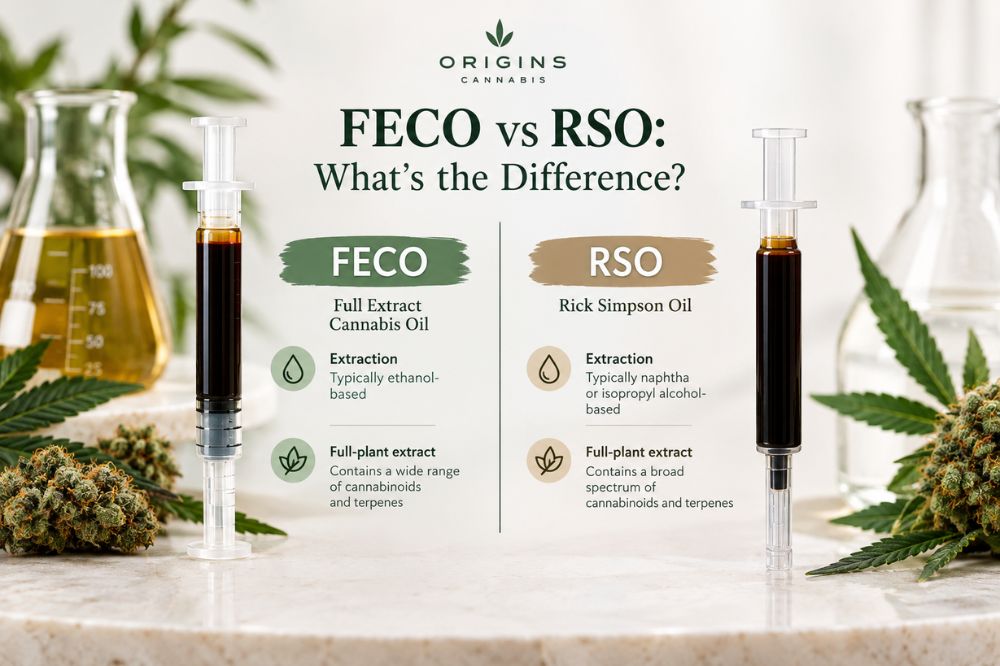
Quick answer: FECO (full extract cannabis oil) and RSO (Rick Simpson Oil) describe the same category of product: a thick, dark, whole-plant oil meant to be swallowed rather than smoked. The split is mostly solvent and vocabulary. RSO points back to Canadian Rick Simpson's method from around 2003, built on naphtha and 99 percent isopropyl alcohol. FECO usually signals food-grade ethanol. Washington labels tell you which.
We get this at the counter most weeks, usually from someone holding two syringes that look identical. They mostly are.
What does FECO stand for, and what does RSO stand for?
FECO stands for full extract cannabis oil. RSO stands for Rick Simpson Oil. One describes a process, one credits a person, which already tells you these terms did not come from the same place or get agreed on by anybody.
Rick Simpson is a Canadian engineer and cannabis activist who began making and giving away a homemade cannabis oil in the early 2000s, after a basal cell skin cancer removal. He published his method and it spread online under his name. Whether the oil did what he said it did for him has never been established in controlled research, and we are not making that claim here. The recipe is documented. That is why the acronym exists.
FECO has no origin story. It appeared later, as a plain description processors and patients could use without invoking Simpson or his claims. Nobody owns it. Nobody standardized it.
Is there an actual product difference between FECO and RSO?
In practice, barely. Both are whole-plant extracts stripped of solvent and reduced to a dark, tarry oil holding cannabinoids, terpenes, chlorophyll, waxes and lipids in one syringe. Both are dosed by mouth in tiny amounts. Both are extremely strong.
The confusion comes from RSO starting as a set of instructions and becoming a category name. Once processors across every legal state printed RSO on syringes, the word stopped meaning "made Simpson's way" and started meaning "thick oral oil." FECO got picked up by people wanting to say "same thing, food-grade ethanol, no naphtha." Anyone telling you there is a bright line between the two is selling one of them.
FECO vs RSO side by side
| Category | FECO | RSO |
|---|---|---|
| Stands for | Full extract cannabis oil | Rick Simpson Oil |
| Origin of the term | Descriptive, no single author | Rick Simpson's published method, circa 2003 |
| Solvent traditionally associated | Food-grade ethanol | Naphtha, 99% isopropyl alcohol, ether |
| Solvent most licensed processors use now | Food-grade ethanol | Food-grade ethanol, in most cases |
| Texture and color | Thick, dark amber to near black | Thick, dark amber to near black |
| Usual format in Washington | Oral syringe, half gram or one gram | Oral syringe, half gram or one gram |
| Typically activated (decarboxylated) | Yes, confirm on the label | Yes, confirm on the label |
| Standardized definition | None | None |
Read that last row twice. Neither term is defined in Washington rule, so two producers can use the same word for different processes and both are legal.
Which solvents are actually used, and does it matter?
Simpson has been clear about what he worked with. His published material names light aliphatic naphtha, 99 percent isopropyl alcohol and ether as the three he has direct experience with, and notes that alcohol pulls more chlorophyll and gives a darker, harsher-tasting oil. Naphtha is a petroleum distillate: an ordinary industrial solvent, and a poor idea in a home kitchen.
Food-grade ethanol is what nearly every licensed processor uses now, whether the syringe says FECO or RSO. It evaporates cleanly at low temperature and does not carry the purge risk of a petroleum product.
Here is the part that actually protects you. Washington requires residual solvent testing on concentrates and extracts regardless of extraction method, covering hydrocarbons, CO2, ethanol and approved food-grade solvents alike. Labs screen a long list with defined limits, from benzene and chloroform at the strictest end to acetone, heptane and ethanol at the loosest. WAC 314-55-105 separately requires the label to disclose the extraction method including solvents or gases used.
So in a licensed store, the solvent question is largely answered before you arrive. A homemade naphtha oil asks you to trust a stranger. A shelf product asks you to trust a lab. That gap is why buying oral oil outside the regulated market is a bad trade, and our piece on how to spot fake cannabis products covers what unregulated packaging gets wrong.
What does "activated" mean on an oral oil?
It means the oil has been decarboxylated: heated long enough that THCA, the acid form the plant produces, loses a carboxyl group and becomes THC. Raw cannabis is mostly THCA. Swallow a non-activated oil and it will not do what you expect.
Most oral oils in Washington stores are activated, because that is the point of the format. A few processors sell non-activated oil deliberately, for people who want acid cannabinoids. The label should say. If it does not, ask, because this detail changes the product more than the name on the front does.
Long, low heat is also why these oils taste the way they do, and why lighter terpenes burn off in production. Our explainer on what terpenes actually do is more use on flower and vapes than on oral oil.
What to read on a Washington label before you buy
Skip the name on the front. Four things on the back and on the certificate of analysis tell you what you have.
Total THC per gram
Washington labels carry total THC calculated for each THC compound present above 0.2 milligrams per gram, plus total CBD. That figure is your dosing math. A gram at 700 milligrams of THC is roughly seventy 10 milligram servings, which is why the syringe format and the tiny doses exist.
Extraction method and solvent
Required disclosure. If it says ethanol, you know what you have. If it says something else, you still know.
Activated or non-activated
Covered above. Confirm it.
Residual solvent and full panel results
The certificate of analysis backs the label. Any licensed Washington processor can supply it, and our Cannabis Guides can pull it up in the store.
Cannabinoid ratio matters too. A high-CBD oral oil behaves differently from a high-THC one, and no indica or sativa tag predicts that. Our breakdown of what the sativa and indica labels actually tell you covers why those categories say almost nothing on a concentrate.
How do people actually use FECO and RSO?
Three ways, in our experience behind the counter. Measured out of the syringe and swallowed. Held under the tongue a minute first. Or stirred into food or a fat like butter or oil, which spreads a dose across servings and softens the taste, similar in principle to making cannabis-infused olive oil.
Some apply it topically, where Simpson's instructions started. Reported effects vary and research on absorption through intact skin is early and mixed.
Why people reach for it is not something we can answer for you, or legally should. Customers tell us they choose oral oil when they want a long, heavy, slow-onset effect from one small dose, and when smoking is not an option. That describes a format, not a health outcome. If you are considering cannabis for a health reason, talk to a healthcare provider who knows your history. Both stores do medical consultations for patients with a Washington DOH recognition card.
Dosing, and the one mistake we see most
People treat a syringe like a serving. It is not. A one gram syringe can hold several hundred milligrams of THC, and oral onset runs one to two hours, so the classic error is redosing at the forty minute mark and having a very long evening.
A portion about the size of a grain of rice is the usual reference point, and even that is more than some people want. Go smaller. Wait a full twenty four hours before adjusting. Skip alcohol on a first try, do not drive, and keep it away from anyone under 21 and away from pets. We wrote a full piece on how much RSO you should take because it deserves more room than a paragraph. Read it before you buy.
What this looks like at our counters
At West Seattle and Redmond, oral oils sit in the concentrates section, and most weeks the shelf carries both names from different producers. When someone asks which is better, we turn the syringes over and compare total THC per gram, activation status and cannabinoid ratio. The acronym almost never decides it.
The other thing we say often: this is not a beginner format. If you want something measurable, a 10 milligram edible or a disposable vape with a known cartridge gives you far more control than a tarry gram in a plunger.
Browse the West Seattle menu or the Redmond menu to see which oral oils are in stock, then ask a Cannabis Guide for the lab panel. We would rather spend ten minutes on the label with you than have you guess.
Frequently asked questions
What is the difference between FECO and RSO?
Both names describe a thick, dark, whole-plant cannabis oil intended to be swallowed rather than smoked. The difference is mostly solvent and vocabulary. RSO points back to Rick Simpson's method, which he documented using naphtha, 99 percent isopropyl alcohol or ether. FECO usually signals food-grade ethanol. There is no legal or industry-wide standard forcing either name to mean one specific thing.
What does FECO stand for?
FECO stands for full extract cannabis oil. It is a descriptive term rather than a brand or a trademark, and no single person is credited with coining it. Processors generally use it to mean a whole-plant oral oil made with food-grade ethanol, positioned as the same kind of product as RSO without the association with Rick Simpson's original solvents.
Is RSO stronger than FECO?
Not inherently. Potency comes from the input material and how far the oil is reduced, not from the name on the syringe. Two products labeled RSO can differ by hundreds of milligrams of total THC per gram. Read the total THC per gram figure on the Washington label instead of assuming one acronym outranks the other.
What does activated or decarboxylated mean on an RSO label?
Activated means the oil has been heated long enough to convert THCA into THC, so it produces effects when swallowed. Non-activated oil is still largely in acid form and will not feel the same taken by mouth. Most oral oils sold in Washington stores are activated, but the label or the product page should say so. Ask if it does not.
Does the solvent used in RSO or FECO show up in the finished product?
Washington requires residual solvent testing on cannabis concentrates and extracts regardless of extraction method, with limits for a long list of solvents including benzene, hexanes, acetone and ethanol. A licensed product on a Washington shelf has passed that screening. The label must also disclose the extraction method and the solvents or gases used.
How much RSO or FECO should I take?
Far less than people expect. These oils are sold by the gram, and one gram can carry several hundred milligrams of THC, so a portion the size of a grain of rice is a common starting reference point rather than a target. Onset by mouth takes one to two hours. Wait a full day before increasing, and speak with a healthcare provider if you use cannabis for a health reason.
Can I buy FECO and RSO at a Washington dispensary?
Yes. Both show up in the concentrates section of licensed Washington stores, usually in oral syringes of half a gram or one gram. Every unit was made by a licensed Washington processor and tracked to the shelf, since nothing legally crosses a state line. Naming varies by producer, so the label matters more than the acronym.