
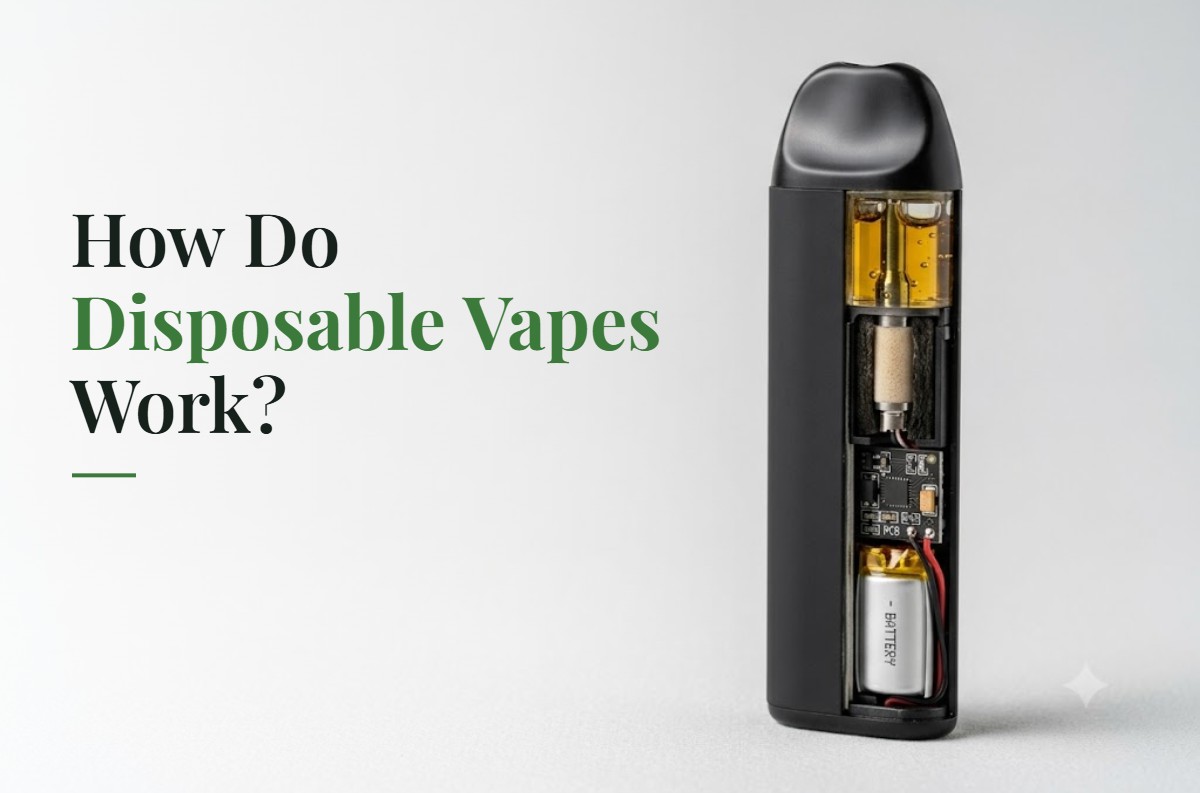
Quick answer: A disposable vape is a sealed lithium battery wired to a heating coil that sits in a tank of cannabis oil. Inhaling drops the air pressure inside the pen, a sensor closes the circuit, and the coil warms the oil to roughly 315 to 400 degrees Fahrenheit. What you draw in is vaporized cannabinoids and terpenes, not smoke. Nothing burns.
Every disposable is a variation on that. What differs is the parts, and what went in the tank.
What happens in the half second after you inhale?
Air pressure drops, and a sensor notices. Nearly every cannabis disposable sold in Washington is draw-activated, so there is no button: a thin diaphragm in the airway flexes when air moves past it, and that flex is the switch.
That signal reaches a chip the size of a fingernail, which connects battery to coil. The coil heats by electrical resistance, the film of oil touching it turns to vapor, and your own airflow carries it up the mouthpiece. Stop drawing and the chip cuts power. Button-fire 510 thread batteries work the opposite way, which is why they can preheat a stubborn cartridge and a disposable cannot.
Most chips run a puff timer too, cutting power around eight to twelve seconds in. That is why a long pull sometimes goes flat halfway through.
What is actually inside a disposable vape pen?
Nine parts, three of which decide how it performs.
| Part | What it does | Worth knowing |
|---|---|---|
| Lithium battery | Powers the coil | Sealed, a few hundred mAh, not replaceable |
| Chip and circuit board | Switches power, runs the puff timer | The blinking light is the chip talking |
| Pressure sensor | Detects your inhale | Sits in the airway, fouls if oil leaks in |
| Heating coil | Turns current into heat | Resistance wire, wound or embedded in a core |
| Wick or ceramic core | Feeds oil to the coil | Porous ceramic in good hardware, cotton in cheap |
| Oil reservoir | Holds the concentrate | Half gram or one gram in Washington |
| Intake holes | Pass oil to the wick | Sized to the oil, and the usual clog point |
| Airway and mouthpiece | Route the vapor out | Where condensation collects into plugs |
| Charging port | Tops up the battery | USB-C on most current pens, absent on older ones |
The battery
Sealed lithium-ion or lithium-polymer, a few hundred milliamp hours. Voltage matters more than capacity for how a pen tastes. Around 2.8 to 3.2 volts aims at flavor. Past 3.5 volts you get bigger clouds and a better chance of scorching the oil. A dead sealed cell ends the pen, which is why USB-C rechargeables took over.
The coil and the wick
This pair decides almost everything. Cheap builds wrap resistance wire around a cotton or silica wick. Cotton is absorbent, cheap, and it scorches. Better hardware uses a porous ceramic core with the element inside it, spreading heat evenly and handling thick oil without the burnt fiber note when it runs dry. Ceramic is not automatically better: an undersized pore structure starves the coil just as fast.
The tank and the intake holes
Oil feeds from the reservoir to the wick through intake holes sized to match it. Roughly 1.0 to 1.2 millimeters suits thin distillate. Thick solventless oil needs 2.0 millimeters or more.
Distillate, live resin, live rosin or cured resin: what is in the tank?
The extract changes the flavor, the price and the hardware the pen needs to work at all.
| Fill | How it is made | How it behaves | Hardware it needs |
|---|---|---|---|
| Distillate | Refined to near-pure cannabinoid | Thin, clear, little native flavor | Small intakes, cotton or ceramic |
| Cured resin | Extracted from dried, cured flower | Medium thickness, some terpenes | Mid-size intakes, ceramic preferred |
| Live resin | Extracted from flower frozen at harvest | Thick, aromatic, holds waxes | Wide intakes, ceramic, lower voltage |
| Live rosin | Solventless, pressed from fresh-frozen hash | Thickest, most heat sensitive | Widest intakes, high-porosity ceramic |
Distillate loses its terpenes during refining, so producers add flavor back, and the label has to say so. Live resin and live rosin keep what the plant made, which is why they taste like the cultivar and need better hardware. What terpenes actually do predicts your experience better than the strain name or the sativa and indica label. For full-plant oral extracts, a different category entirely, see our FECO and RSO comparison.
What temperature does the coil run at, and why does it matter?
Low enough to keep the flavor, high enough to move vapor. Cannabinoids and terpenes each boil at their own point, which is why one oil tastes different at different power levels.
- Caryophyllene, about 246F
- Alpha-pinene, about 312F
- THC, about 314F
- Myrcene, about 330F
- Limonene, about 350F
- Linalool, about 388F
Run cool and the light aromatics arrive first. Run hot and you get more vapor with a flatter, harsher taste, because the delicate compounds already left.
Past that it stops being about flavor. Work published in ACS Omega in 2019 by Meehan-Atrash, Luo, McWhirter and Strongin found that heating cannabis concentrates hard produces degradation products including methacrolein, benzene and isoprene, with terpene-rich material generating more of some than pure THC did. Their rig ran near 370C, hotter than any vape pen, but the direction holds: heat makes the unwanted compounds.
Short draws, with pauses. That is the technique.
How do you use one without ruining it?
Store it upright, mouthpiece up. Oil migrating into the airway or the sensor is the most common cause of a pen that gurgles, leaks or dies early. Keep it near room temperature, out of a parked car in August and a bag in a Seattle January. Cold oil feeds the wick slowly and leaves the coil firing dry, so warm the pen in your hand first.
Why is my disposable vape not hitting?
Four things cause nearly all of it: a flat battery, a clog, a dry wick, or oil where it should not be.
| Symptom | Likely cause | What to try |
|---|---|---|
| No vapor, no light | Battery flat or protection tripped | Charge it if it has a port, then draw gently |
| Light blinks | Low battery, short, or puff timer tripped | Charge, stop chaining pulls, check the port for oil |
| No airflow at all | Condensed oil plugging the airway | Warm in hand, draw with no power, clear with a toothpick |
| Burnt taste | Coil firing on a dry wick | Pause between draws, warm the pen, check the oil level |
| Gurgling or spitting | Flooded coil, from heat or side storage | Stand it upright, draw gently, let it settle |
| Thin, weak vapor | Cold oil or a fading battery | Warm it first, then charge |
| Oil left but pen dead | Sealed battery at end of life, or a fouled sensor | Charge if it has a port, otherwise bring it back |
That last row reaches our counter most. A non-rechargeable pen with oil still in the window is a hardware failure, not user error, and a licensed store should stand behind it. Bring the packaging.
What does a Washington vape label tell you?
More than most people read. Under WAC 314-55-105, the Washington State Liquor and Cannabis Board requires concentrate labels to carry the producer's business name and UBI number, the lot number, net weight, total THC and total CBD, the extraction method including every solvent used, and a full list of additives, thickening agents and terpenes added during production.
That additive list is the part worth your attention. Processors also file a Cannabis Vapor Product Ingredient Disclosure with the LCB under WAC 314-55-1055, synthetic terpenes are not permitted here, and vitamin E acetate is banned outright following the State Board of Health's action after the 2019 lung injury outbreak.
No lot number and no additive list means it did not come through the regulated system. Our guide to spotting fake cannabis products covers the rest of the tells.
What we check before handing one over
Our Cannabis Guides in West Seattle and Redmond get asked to pick a disposable dozens of times a day, and we ask the same things back. What is the fill. Does it charge. And when was it packaged, because terpenes fade in a tank the way they fade in a jar.
Whether a disposable is the right format for you is a separate question, and our pros and cons of disposable vapes piece handles it.
Frequently asked questions
How long does a disposable vape last?
It depends on fill size and draw length. A half gram pen taken in three second pulls gives most people roughly 150 to 200 draws, a few days to a couple of weeks of light use. Longer pulls burn oil and battery faster, so puff-count claims on a box are rough at best.
Can you recharge a disposable vape?
Many current disposables have a USB-C port on the base, and those are meant to be topped up so the battery outlives the oil. Older sealed units have no port and cannot be recharged safely. Use the cable the manufacturer specifies, and never leave a pen charging overnight or in a hot car.
Why does my disposable vape taste burnt?
A burnt taste means the coil fired while the wick was dry. That happens when the tank is nearly empty, when the oil is too cold to feed back, or when you chain long pulls with no pause. Rest the pen a minute between draws and keep it near room temperature. Scorched oil never tastes right again.
How do you fix a clogged disposable vape?
Warm the pen in your hand for a few minutes so the oil thins, then take a couple of gentle draws with no power to pull the plug through. If the airway still resists, a thin wooden toothpick worked into the mouthpiece clears condensed oil. Never put a lighter or heat gun to a lithium battery.
Do disposable vapes work in cold weather?
Poorly, until they warm up. Cannabis oil thickens as the temperature drops, so it feeds the wick slowly and the first draws come out thin or scorched. Lithium batteries also deliver less current when cold. In a Seattle winter, keep the pen in an inside pocket and give it a minute in your hand.
Are the terpenes in a disposable vape natural or added?
Both exist on Washington shelves, and the label has to say which. Live resin and live rosin carry terpenes from the plant itself. Distillate has almost none left after refining, so producers add them back. Washington processors must disclose every additive and terpene used, and synthetic terpenes are not permitted here.
Reading the pen instead of the packaging
Once you know which part does what, most of the frustration goes away. Warm oil feeds. Cold oil does not. Short draws taste better than long ones.
The West Seattle vape menu and the Redmond vape menu list fill type and producer for what is in stock. Ask a Guide which pens use ceramic.
Origins Cannabis is a licensed Washington retailer serving adults 21 and over in Redmond and West Seattle. Nothing here is medical advice. If you have questions about inhalation and your health, talk to a healthcare provider who knows your history.