
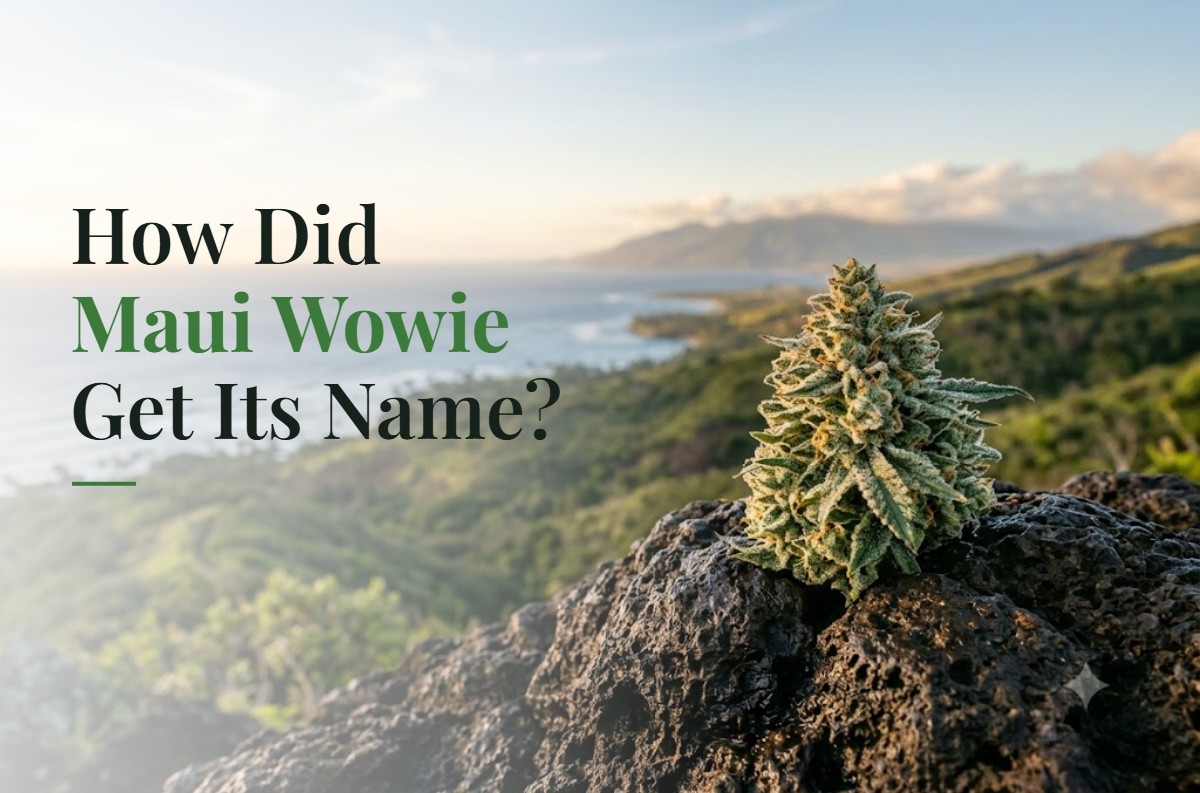
Quick answer: Maui Wowie got its name from mainland visitors to Maui in the 1960s and 1970s who were not ready for the local sativa. The island's open-pollinated tropical genetics, grown in volcanic soil at elevation on the slopes of Haleakala, produced flower that was noticeably brighter and stronger than what most people smoked at home. "Wowie" was the review. The place name and the reaction fused into a nickname, and it stuck for sixty years.
Nobody signed their name to it. There is no breeder, no seed company press release, no cup win that started it. That is unusual for a strain this famous, and it is the most honest part of the story.
Where does the name Maui Wowie come from?
The name is surf and hippie slang from Maui, and it describes the reaction rather than the plant. Through the late 1960s and 1970s, Maui had a steady flow of mainland visitors coming through Lahaina, Paia and the Hana road, and a lot of them ended up smoking cannabis grown a few miles up the hill from where they were staying. It did not smell like Mexican brick. It did not feel like it either.
The word travelled home with them. By the early 1970s "Maui Wowie" was showing up in American slang as shorthand for exceptionally strong island weed, in the same way "Acapulco Gold" and "Panama Red" worked as shorthand for specific imported qualities. All three names are geography plus a promise.
What makes Maui Wowie unusual among those names is that it never really described a fixed variety. Acapulco Gold pointed at a look. Panama Red pointed at a color. Maui Wowie pointed at a feeling, which is a much harder thing to keep honest on a jar label fifty years later.
Is it Maui Wowie or Maui Waui?
Both, and the difference tells you who was writing it down. Maui Waui is closer to how it was actually said in Hawaii, and older Hawaiian growers and long-time residents still spell it that way. Maui Wowie is the mainland spelling, the one that magazines and later seed catalogs settled on, and it is now the version that carries the search volume and the shelf space.
If you see Maui Waui on a Washington menu, it is usually a deliberate nod to the older usage rather than a different plant.
What made Maui cannabis different in the first place?
Three things, and only one of them was genetics.
The dirt and the light
Maui's growing conditions are close to ideal for long-flowering tropical sativas. The soil on the volcanic slopes drains hard and holds minerals. The day length stays consistent enough year-round that a plant with a twelve or fourteen week flowering time can actually finish, which is not true in most of the continental United States. Growers could plant at elevation, get real UV exposure, and let plants run the full season without racing an autumn frost.
That last point matters more than people assume. A lot of what separates legendary tropical sativas from their mainland copies is simply that the original had time to finish and the copy did not.
The genetics that arrived by boat
Hawaii sat on shipping and travel routes that brought seed in from Thailand, Colombia, Mexico and South and Southeast Asia through the 1960s and 1970s. Those seeds went into the ground, cross-pollinated freely, and got selected year after year by growers keeping the plants that performed on that particular hillside. Several decades of that produces something with real regional character.
It also means Maui Wowie sits slightly outside the strict definition of a landrace. A landrace population has usually been isolated and locally adapted for a very long time. Maui's was assembled fast, from imported stock, inside living memory. Heirloom is the more accurate word, and it takes nothing away from the plant.
The growers
The people who made it were not commercial operators. They were small growers on family land, often working plots of a few dozen plants, selecting by taste and by what their friends came back for. There was no catalog and no branding. Reputation moved by word of mouth, which is exactly why the name outlived any specific seed line.
What happened to Hawaiian cannabis after 1978?
Operation Green Harvest happened. Starting in 1978 and continuing in various forms until 2009, state and federal agencies ran helicopter-based eradication sweeps across the Hawaiian islands, spotting outdoor plots from the air and destroying them. For a grower with a visible hillside patch, the economics collapsed overnight.
The effect on the plants was permanent. Large open-pollinated outdoor populations are how regional cannabis genetics stay diverse and stay themselves. Break them into small hidden patches, push growers indoors, or push them out of the business entirely, and the gene pool narrows fast. A lot of what got called Maui Wowie in the 1980s was already a different plant from what got called Maui Wowie in 1972.
By the time seed companies started formally selling Hawaiian sativa lines, they were mostly working from whatever seed had survived off-island, crossed with something faster and shorter to make it commercially viable. That is the version most of the market descends from now.
Is the Maui Wowie on dispensary shelves the real thing?
Mostly no, and the honest answer is more useful than the marketing one. Almost every Maui Wowie sold in a licensed Washington store is a modern hybrid bred to hit the flavor and the feel of the original, not a preserved Hawaiian cutting. Some of them are very good. None of them came off Haleakala.
There is also a hard legal reason it cannot be otherwise. Washington's cannabis market is a closed system under the Washington State Liquor and Cannabis Board, which means every gram sold here was grown here by a licensed Washington producer and tracked from seed to shelf. Nothing crosses a state line legally, ever. So a Hawaiian-origin plant would have to have arrived as genetics years ago and been grown out locally since.
Treat the name as a description of a profile, the same way you would treat any strain name on a menu. Then check the thing that actually predicts what you will experience.
What to look at instead of the name
The terpene panel, the harvest date and the grower. In that order.
| What you are checking | What it tells you | What to look for on a Maui Wowie |
|---|---|---|
| Terpene percentages | The best available signal for aroma and character | Terpinolene and limonene present, ideally 1 percent or more total terps |
| Harvest or packaged date | How much of that aroma is still in the jar | Under six months, ideally under three |
| Producer name | Whether anyone is actually selecting for this profile | A Washington farm that repeats the cultivar year to year |
| THC percentage | Less than you have been told | Useful as a rough range, useless as a quality score |
| Trichome look and bud structure | Cure quality and handling | Loose, airy, resinous structure is normal for tropical sativas |
If a jar labeled Maui Wowie is heavy on myrcene and smells like damp earth, it may still be lovely flower. It is just not doing the thing the name promises. Our guide to what terpenes actually do goes deeper on reading those panels.
What does Maui Wowie taste and feel like?
Pineapple first, usually, with ripe mango behind it and a sweet citrus lift. Good examples have a faint incense or light diesel note sitting underneath the fruit that keeps it from tasting like candy. The smoke tends to be soft and the ash light.
The reported effects skew bright, chatty and physically light, which is why people file it as a daytime option. Worth saying plainly: the sativa label on the jar is a weak predictor of any of that. Effects vary by chemovar, by dose, by tolerance and by the person. Our breakdown of what the sativa and indica labels actually tell you covers why that is.
Start with less than you think you need if it is new to you.
Where Maui Wowie fits in the wider sativa family
It sits in the same conversation as the other geography-named tropicals: Acapulco Gold out of Guerrero, Panama Red, Thai sticks, Colombian Gold. Several of those fed into the Haze family, which is where a lot of modern sativa genetics come from. If the history side of this interests you, our primer on landrace strains is the wider map.
Finding it in Seattle and Redmond
Tropical sativa flower moves in and out of Washington menus seasonally, so it is worth asking rather than assuming. Our Cannabis Guides at Redmond and West Seattle can tell you which producers are currently running Hawaiian-leaning cultivars and which jars have the terpene numbers to back the label. You can also scan the current West Seattle flower menu or the Redmond flower menu before you come in.
Ask for the terp panel. Ask when it was packaged. If the name is the only thing selling it, keep looking.
Frequently asked questions
How did Maui Wowie get its name?
The name is 1960s and 1970s slang. Visitors to Maui found the local sativa far stronger and clearer than what they smoked on the mainland, and "wowie" was the reaction. The place name and the exclamation stuck together into a nickname, and the nickname outlived the growers who made it famous. No single person is credited with coining it.
Is it Maui Wowie or Maui Waui?
Both spellings have been in use since the 1970s. Maui Waui is closer to how it was said out loud in Hawaii. Maui Wowie is the spelling that mainland magazines and later seed catalogs standardized on, which is why it dominates dispensary menus and search results today.
Is Maui Wowie a landrace strain?
The original Maui population came from imported sativa seed that adapted to the island over several decades, so it is better described as a Hawaiian heirloom than a true ancient landrace. Almost every Maui Wowie sold in a licensed store today is a modern hybrid bred to echo that profile rather than a preserved island cutting.
What does Maui Wowie taste like?
Pineapple, ripe mango and a sweet citrus edge, often with a light diesel or incense note underneath. That fruit character usually tracks with terpinolene and limonene on the lab panel. If a jar labeled Maui Wowie smells flat or purely earthy, the terpene profile is telling you something the name is not.
What are the effects of Maui Wowie?
Customers most often describe it as bright, talkative and easy to stay busy on, which is why it reads as a daytime option for many people. Effects vary by person, by chemovar and by dose, and the sativa label on the jar is a poor predictor on its own. Start low if you are new to it.
Why did Hawaiian cannabis almost disappear?
Operation Green Harvest, a helicopter-based eradication program that ran in Hawaii from 1978 into 2009, made large outdoor grows extremely risky. Growers moved into smaller hidden plots or indoors, and many old open-pollinated Hawaiian populations were lost or heavily diluted along the way.
Can I buy real Hawaiian Maui Wowie in Washington?
You can buy Maui Wowie in Washington, but it will have been grown here by a licensed Washington producer, because the state's traceability system does not allow cannabis to cross state lines. What you are buying is a Washington-grown expression of the genetics, which can still be excellent.
Origins Cannabis is a licensed Washington retailer serving adults 21 and over in Redmond and West Seattle. Nothing here is medical advice. If you are using cannabis for a health reason, talk to a healthcare provider who knows your history.