
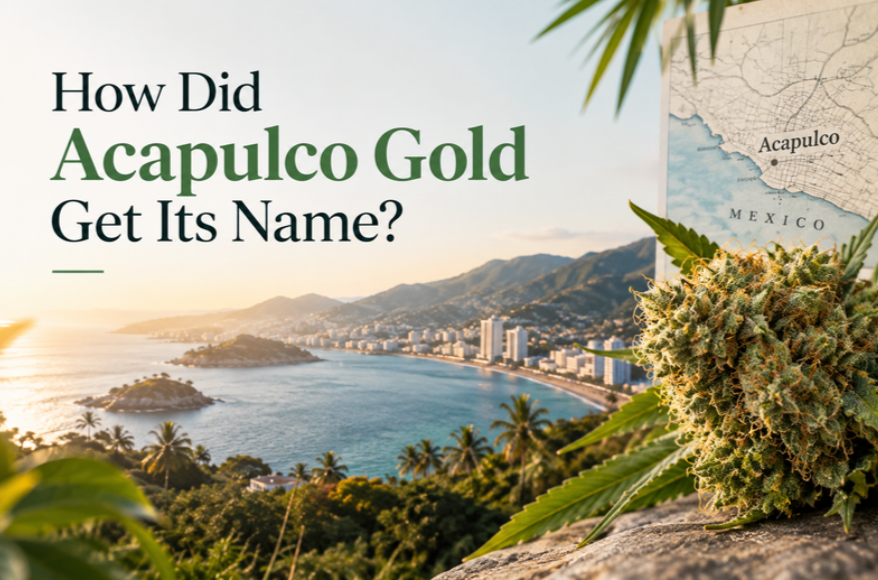
Quick answer: Acapulco Gold got its name from its color. Cannabis grown in the hills of Guerrero, the Mexican state that holds Acapulco, reached American buyers in the 1960s looking amber and straw gold instead of green. Buyers called it gold, and the name became shorthand for the best imported Mexican flower. The Oxford English Dictionary later recorded the color as brownish gold, or gold mixed with green.
The name is a description. That is what separates it from most famous strain names, which are jokes, tributes or marketing.
Where does Acapulco Gold actually come from?
Not Acapulco. The plant came out of the hill country of Guerrero, the Pacific coast state whose best known city is Acapulco, in and around the Sierra Madre del Sur range behind the beach towns. Acapulco was the port, the airport and the word Americans recognized, so Acapulco went on the product. Names follow shipping routes, not growing regions.
Guerrero suited the plant. Long season, high UV at elevation, a dry finish into late autumn, and enough remote hillside to plant without an audience. A tropical sativa with a twelve to sixteen week flowering time can actually finish there, which is not true across most of the continental United States. The term was first recorded in the United States in 1964.
Why did Acapulco Gold turn gold?
Three causes stacked, and none of them are mysterious. The plants finished very late in strong sun, chlorophyll broke down and let the yellow and amber pigments underneath show through, and the flower then spent weeks drying and moving north before anyone lit it.
Chlorophyll leaves before the plant is finished
Green in a cannabis plant is chlorophyll, and chlorophyll is fragile. Late in flowering, as the plant moves into senescence and pulls nutrients back out of its leaves, chlorophyll degrades faster than the carotenoid pigments sitting alongside it. Those carotenoids are yellow, orange and amber. They were always there. They only show once the green in front of them breaks down.
Same process that turns a maple leaf in October. Some cultivars express it hard, some barely at all, and the Guerrero populations ran toward the amber end.
Sun, wind and a very long trip north
Field drying in direct tropical sun bleaches whatever pigment is left. The smuggler Gary Tovar credited the color to plants aged and dried in the wind off the Pacific, which is unverifiable but plausible as a mechanism.
Then there is time. This flower was cut, dried outdoors, pressed, moved by road, boat or small plane, warehoused and sold, often months later. Old cannabis loses green. Some of the gold Americans admired was age, and they had nothing fresher to compare it to.
Part of it was grading, not botany
Most articles skip this part. By the early 1970s "gold" had drifted into use as a quality grade for imported Mexican flower generally, and Acapulco Gold later became a generic term for high grade marijuana in mainstream writing. Plenty of what sold under the name was ordinary Mexican product that looked tawny. No testing, no labeling, no traceability. The name traveled faster than the genetics.
Did the gold color mean it was better weed?
Not by itself. Color reflects pigment and age, and says nothing directly about cannabinoid or terpene content.
Gold worked as a signal in 1968 because flower that looked that way usually did come from a particular region and a full-length finish, and the alternative was leafy, seeded brick weed. Decent proxy then. Bad proxy now. A modern bud that looks amber is far more likely to be old or heat-damaged than exceptional, one reason price and quality track each other unevenly on a dispensary shelf.
Is Acapulco Gold a real landrace?
Broadly yes, with an asterisk. The Guerrero population is usually classified as a Mexican landrace, a regional population that adapted locally over generations rather than one bred deliberately by anyone. Some accounts fold Nepalese or other imported genetics into the background. Neither version has paperwork.
What is not in dispute: no unbroken commercial seed line runs from those hillsides to a Washington grow room. Our primer on landrace strains covers how these populations formed and why so few survived.
What did Operation Intercept do to the supply in 1969?
Less than its reputation suggests. Operation Intercept ran from September 21 to October 11, 1969, applying near-total inspection to vehicles crossing from Mexico, plus radar coverage, Navy presence in the Gulf and screening at airports handling Mexican flights. Seizure volumes came in no higher than the ordinary pre-operation average. Searches were cut back after about ten days and abandoned inside three weeks, under pressure from border communities and from Mexican president Gustavo Diaz Ordaz, then folded into a bilateral agreement called Operation Cooperation.
It did produce a short, sharp shortage in autumn 1969, which pushed buyers toward hashish, toward other drugs and toward growing at home. As enforcement it failed. As a nudge toward domestic cultivation it worked better than the growers could have arranged themselves.
What actually ended the Mexican import era?
Paraquat, and the fear of it. Starting in 1975, Mexican eradication flights supported by United States helicopters and funding sprayed the herbicides paraquat and 2,4-D on cannabis fields. Sprayed flower did not stop existing. It got harvested anyway and shipped north.
In April 1978, Health, Education and Welfare Secretary Joseph Califano warned publicly that heavy daily smoking of contaminated marijuana could cause irreversible lung damage. Federal sampling of border seizures found paraquat in roughly a fifth of batches, and a private lab reported a higher share. Senator Charles Percy pushed to halt the marijuana spraying specifically. Home test kits sold out. Whether anyone was actually harmed stays unclear, and later work suggested most paraquat is destroyed by combustion heat, but the damage to demand took weeks.
American buyers stopped trusting Mexican weed. That is the real reason the gold vanished, and it is a different story from the helicopter eradication campaigns that hit Hawaii a few years later, which we cover in the piece on how Maui Wowie got its name.
What replaced imported landrace cannabis?
Domestic sinsemilla, and the market never went back. Around 72 percent of American cannabis in the 1970s was imported, Colombia supplying the largest share, most of it arriving as pressed kilo bricks: seeds, stems, leaf and flower together, months old. Once buyers had reason to distrust imports, growers in California, Oregon and eventually Washington answered by removing males and selling unpollinated flower.
Seedless flower meant selection, selection meant breeding, and by the 2000s sinsemilla had gone from a small fraction of seized samples to the majority. The imported sativas fed the Haze family and much of what followed. The regional names outlived the regional plants.
Imported landrace era versus the modern shelf
| Category | Imported landrace era, roughly 1960–1978 | Modern licensed Washington market |
|---|---|---|
| Typical color | Gold, amber, tan, often bleached | Green, sometimes purple, amber reads as a fault |
| Freshness at purchase | Months old, sometimes a year | Packaged date printed, often weeks |
| Seeds and stems | Standard, pressed into bricks | Effectively none, sinsemilla only |
| Potency | Low by current standards, unknown to the buyer | Lab tested percentages on every jar |
| Terpene information | None | Full panel on many products |
| Who grew it | Unknown, unnamed | Named licensed producer, tracked seed to sale |
| Consistency | Varied batch to batch | Repeatable cultivars year over year |
The trade ran both ways. You gained information and freshness. You lost open-pollinated regional populations nobody thought to preserve.
Is the Acapulco Gold on our shelf the real thing?
No, and we would rather say so. Any flower labeled Acapulco Gold in a licensed Washington store is a modern recreation, grown here, bred to gesture at the old profile. Washington runs as a closed system under the Washington State Liquor and Cannabis Board, so nothing crosses a state line and nothing arrives from Guerrero. Some of these recreations are very good. None are the plant from 1968, and a grower who says otherwise is selling a story.
Read the terpene panel, because terpenes carry more useful information than the name does. Expect peppery, citrus and woody notes rather than the candy sweetness of most modern hybrids. Check the packaged date.
What our Cannabis Guides say at the counter
Nobody walks into our Redmond store asking for Acapulco Gold because of a terpene profile. They ask because they remember the name, or their father did. Good enough reason, and we will point you at the closest match on the shelf.
We will also say that the sativa label predicts less than you would like, which our breakdown of what sativa and indica actually tell you gets into. Reported effects for these Mexican-leaning cultivars skew clear-headed and daytime, but that varies by person and dose. Start low if it is new to you, and talk to a healthcare provider if you are using cannabis for a health reason.
The naming stories rhyme. Alaskan Thunder Fuck is another place name doing the work of a quality claim.
Frequently asked questions
How did Acapulco Gold get its name?
It was named for its color. Cannabis grown in the hills of Guerrero, the Mexican state that holds Acapulco, arrived in the United States looking amber and straw gold rather than green, and American buyers named it after the port city they associated it with. The Oxford English Dictionary records the color as brownish gold, or gold mixed with green.
Why was Acapulco Gold gold instead of green?
Several causes stacked up. The plants finished late in strong tropical sun, chlorophyll broke down and let yellow and amber pigments show through, and the flower then spent weeks drying and traveling before anyone smoked it. Old cannabis loses green. Some sellers also used the word gold as a grade rather than a literal description, which muddied the record.
Did the gold color mean the weed was stronger?
Not on its own. Color tracks pigment chemistry and age, not cannabinoid content. Gold was a useful signal in the 1960s because flower that looked that way tended to come from a specific region and a longer finish, but a modern bud that looks amber is more likely to be old or badly cured than exceptional.
What was Operation Intercept?
A border inspection surge ordered by the Nixon administration that ran from September 21 to October 11, 1969, applying near-total vehicle searches at Mexican crossings. Seizure volumes came in below expectations, searches were scaled back within about ten days, and it was replaced by a joint agreement called Operation Cooperation.
Why did Mexican cannabis imports lose their reputation?
Paraquat. From 1975 the United States supported Mexican eradication flights that sprayed paraquat and 2,4-D on cannabis fields, and sprayed product reached American buyers anyway. In April 1978 HEW Secretary Joseph Califano issued a public health warning about contaminated marijuana, and buyer confidence in Mexican imports never recovered.
Can I buy real Acapulco Gold in Washington?
You can buy flower labeled Acapulco Gold, grown in Washington by a licensed producer, because the state's traceability system under the WSLCB does not allow cannabis to cross state lines. Treat the name as a description of an intended profile, then check the terpene panel and the packaged date before you decide.
Worth remembering
The gold was partly genetics, partly sunlight and partly the fact that nothing traveled fast in 1968. Calling it a golden age is fair, as long as you remember the flower was seeded, months old and untested, and people loved it anyway because they had no idea what else was possible.
To try the modern interpretation, scan the West Seattle flower menu or the Redmond flower menu and see who is running Mexican-leaning sativas. Ask a Cannabis Guide what the terp panel says. That is the part the 1960s never got to check.