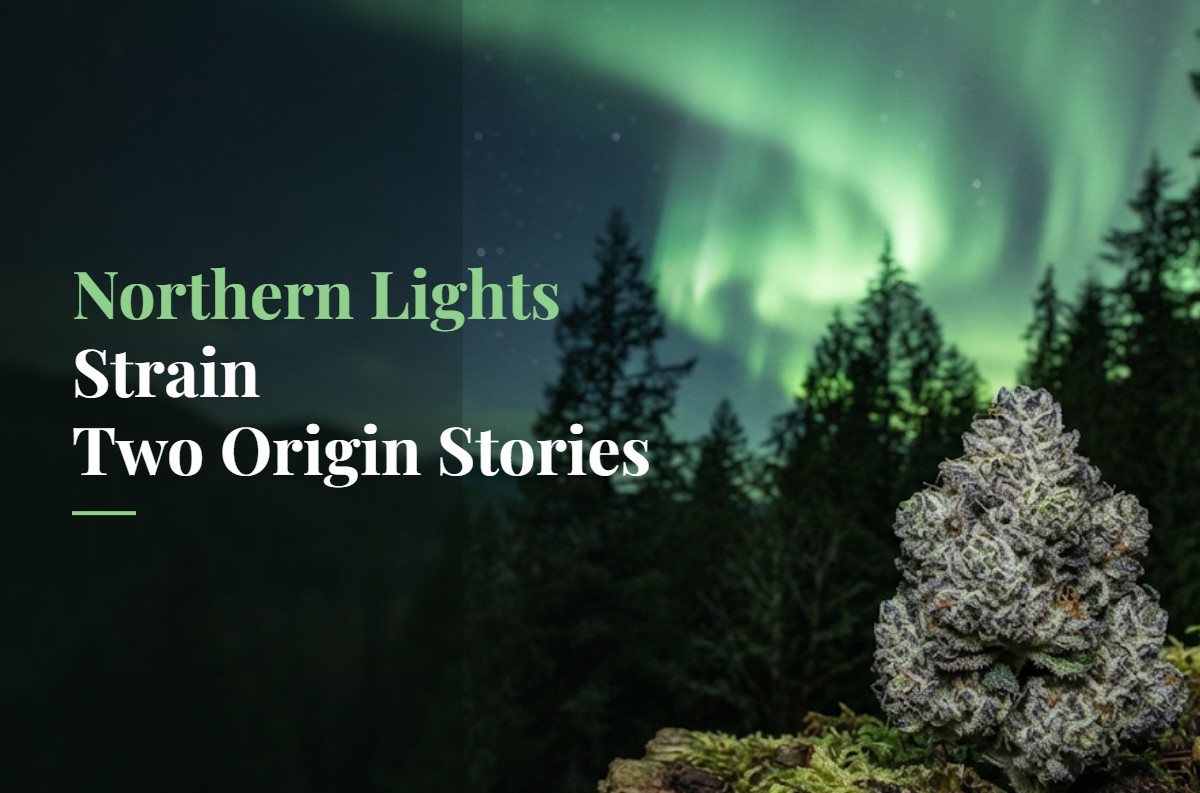
Quick answer: Northern Lights is an indica-dominant cannabis strain built from Afghani and Thai landrace genetics, famous since the 1980s for dense buds and a short flowering time. Its origin is disputed. One account places it in the Pacific Northwest in the late 1970s, another credits Dutch breeders who stabilized it after 1985.
What is Northern Lights, at a glance?
Northern Lights is one measured answer to a simple question: how fast can an indica finish indoors without losing resin? Here is the summary we would give you across the counter.
| Field | What the sources say |
|---|---|
| Reported lineage | Afghani and Thai landrace genetics, per Leafly, Sensi Seeds and SeedFinder |
| Breeder and era | Attributed to a Pacific Northwest grower in the late 1970s, stabilized by Nevil Schoenmakers in the Netherlands from 1985 |
| Typical THC | 18 percent, with 1 percent CBG, per Leafly |
| Dominant terpenes | Myrcene first, then caryophyllene and limonene, per Leafly |
| Reported downsides | Dry mouth 30 percent, dry eyes 15 percent, dizziness 7 percent, per Leafly reviewers |
| Flowering time | 45 to 50 days, per Sensi Seeds. SeedFinder growers report about 48 days indoors |
| Flavor and aroma | Earthy and pungent, with pine, citrus and a sweet spice note |
A landrace, for anyone meeting the word here, is a population that adapted to one region over generations without deliberate crossbreeding. Our landrace strains explainer covers why those plants still matter to modern genetics.
Who actually bred Northern Lights?
Nobody can prove it, and the two surviving accounts do not cancel each other out. Both are probably partly true.
The Pacific Northwest account
SeedFinder records a legend about a breeder known as The Indian. He grew the earliest Northern Lights plants in the 1970s, on or near islands outside Seattle. Beard Bros Pharms gives the same story and places the origin in the Pacific Northwest in the late seventies.
Neither source produces a document. As Beard Bros notes, early growers worked outside the law and avoided written records for good reason.
The Netherlands account
SeedFinder says Nevil Schoenmakers found the strain in the United States in 1985, took clones to the Netherlands, and stabilized it there. Beard Bros adds that Schoenmakers founded The Seed Bank, Europe's first major cannabis seed company. He also acquired several of the original numbered cuts.
Sensi Seeds, which absorbed that work, describes Northern Lights as redeveloped by Sensi Seeds from Thai and Afghani landrace genetics. It lists the strain as a Cannabis Cup gold winner.
What both accounts agree on
| Point | Pacific Northwest account | Netherlands account |
|---|---|---|
| Genetics | Afghani with Thai influence | Afghani and Thai landrace |
| Date of first plants | Late 1970s | Not disputed |
| Where it was stabilized | Not claimed | Netherlands, after 1985 |
| Documentation | None | Seed company records only |
Both sides place the raw genetics in the 1970s and the stabilization in the Netherlands. The fight is over credit, not sequence. We handle the same problem with White Widow's contested origin story.
Is Northern Lights an indica or a sativa?
It is sold as an indica, and Sensi Seeds gives its own version as 90 percent indica and 10 percent sativa. Leafly also lists it as an indica.
That number describes the plant, not your evening. Growers use the ratio to predict height, leaf shape and finish time. It is a poor predictor of how a particular jar will land.
We say this on every strain page, so read what the sativa and indica labels actually tell you before you shop by category.
What is the THC percentage of Northern Lights?
Leafly lists 18 percent THC and 1 percent CBG for Northern Lights. By 2026 Washington standards that is moderate, not weak.
Plenty of flower on our shelf tests above 25 percent. A Northern Lights harvest grown well can land there too, and a tired cut can come in near 14 percent.
The strain average is not your jar. Ask us for the certificate of analysis, which every licensed Washington batch has.
What terpenes does Northern Lights carry?
Myrcene leads, followed by caryophyllene and limonene, according to Leafly's aggregated data. That matches the earthy, slightly peppery profile most people describe.
Abstrax builds terpene blends for the extract industry. It names a different top four for its Northern Lights profile: terpinolene, beta-caryophyllene, limonene and myrcene. That disagreement is the point.
Terpene content swings hard between growers, cuts and cure methods. If you want to know what each compound does, our page on what terpenes actually do is the place to start.
What does Northern Lights smell and taste like?
Earthy and pungent, with a sweetness that develops after cure. Sensi Seeds describes an earthy, rich, pungent aroma that intensifies as harvest approaches, with fruit and herb notes becoming clearer after curing.
Abstrax describes the aroma as sweet and slightly spicy with hints of pine and citrus. It notes that skunky notes come through more on the palate than in the jar.
In practice, a good Washington Northern Lights smells like damp earth, sweet pine and black pepper.
What do people report after using Northern Lights?
Relaxation and sleepiness dominate the reviews. Leafly's data from 2,889 reviewers reports 72 percent feeling relaxed, 48 percent sleepy and 29 percent hungry.
The reported downsides are the standard ones. Dry mouth came in at 30 percent, dry eyes at 15 percent and dizziness at 7 percent.
Treat all of that as a rough signal. These are self-reported ratings from people who already chose the strain, not a controlled measurement.
What is Northern Lights #5, and does it matter?
Northern Lights began as a numbered series of selected plants, and the fifth selection became the most used in breeding. Beard Bros Pharms describes the strain as starting from a numbered series without listing all the cuts.
Northern Lights #5 is a selection, not a separate strain. Its most famous use is Northern Lights #5 x Haze, which put the indica structure behind a long-flowering sativa.
That cross matters more than most people realize. Leafly lists Silver Haze and Green Goblin among Northern Lights offspring, and Shiva Skunk and Super Silver Haze among its descendants. Our haze strain guide picks up that thread.
Is the Northern Lights on a Washington shelf the same plant?
Probably not, and no Washington document says otherwise. This is the part most strain pages skip.
Under WAC 314-55-102, Washington requires six tests on useable cannabis: water activity, cannabinoid concentration, foreign matter, microbiological, mycotoxin and pesticide. Terpene analysis is something a lab may be certified for, not something the rule requires.
Nothing in the rule verifies genetics or names. A jar labeled Northern Lights carries the name its grower uses for that cut. That is the whole of the guarantee.
The myth worth correcting about Northern Lights
The myth is that Northern Lights is a pure Afghani indica. It is not, and the breeders say so themselves.
Sensi Seeds, SeedFinder and Leafly all describe Thai landrace genetics in the lineage. The Thai side is why some Northern Lights phenotypes stretch taller and finish lankier than a true Afghani plant.
There is a second thing worth admitting. Nearly every Northern Lights history online, including large sites, repeats the same two accounts without new evidence. We have not found a primary document for either, and we are not going to pretend otherwise.
If provenance matters to you, the grower is a better question than the name. Our guide to finding out who grew your weed explains how to read a Washington label backwards to the farm.
Who should probably pick something else?
Anyone who needs to stay sharp for the rest of the day. Half of Leafly's reviewers reported sleepiness, and that is a lot for a strain often recommended to beginners.
If you are new to cannabis, the 18 percent figure is friendlier than most of our shelf. Start with a single small hit and wait 15 minutes before a second.
If you want something with more lift, Northern Lights is the wrong end of the catalog. Browse our indica-dominant strain roundup to see where it sits against its neighbors.
Frequently asked questions
Is Northern Lights an indica or a sativa?
It is sold as an indica, and Sensi Seeds lists its own Northern Lights as 90 percent indica and 10 percent sativa. Leafly also classes it as an indica. Keep in mind that the split describes plant shape and growing habit more than it predicts how a given jar will feel. Washington labels are not required to carry a verified ratio at all.
Who created the Northern Lights strain?
Nobody can prove it. The oldest account credits an American grower nicknamed The Indian, working in the Pacific Northwest in the late 1970s. Nevil Schoenmakers then acquired the genetics in the mid 1980s. He moved them to the Netherlands and stabilized them through his Seed Bank. That company later became Sensi Seeds. Both parts are reported history, not documented record.
What are the parent strains of Northern Lights?
Afghani and Thai landrace genetics. Leafly, Sensi Seeds and SeedFinder all give the same pairing, which is unusual for a strain this old. The Afghani side explains the dense, resinous buds and short flowering. The Thai side explains why some phenotypes grow taller and lankier than a pure Afghani plant would.
How strong is Northern Lights?
Leafly lists Northern Lights at 18 percent THC and 1 percent CBG. That is a moderate figure by 2026 standards, since plenty of Washington flower tests above 25 percent. Individual harvests vary a lot, so read the label on the jar in front of you rather than the strain average. Ask us for the certificate of analysis if it matters to you.
What is the difference between Northern Lights and Northern Lights #5?
Northern Lights began as a numbered series of selected plants, and the fifth cut became the most used in breeding. Northern Lights #5 is a specific selection from that series, not a separate strain. It appears in famous crosses such as Northern Lights #5 x Haze. Most product simply labeled Northern Lights is not from that numbered line.
What do people report after using Northern Lights?
Across 2,889 Leafly reviews, 72 percent reported feeling relaxed, 48 percent sleepy and 29 percent hungry. The most reported downsides were dry mouth at 30 percent, dry eyes at 15 percent and dizziness at 7 percent. Those are self-reported numbers from reviewers, not a measurement, so treat them as a rough signal.
Looking for Northern Lights in Seattle or Redmond?
Stock moves, and a famous name does not guarantee a famous jar. Ask a Cannabis Guide what the current Northern Lights batch actually tested at, and whether a different Afghani cut is growing better this month.
Check the West Seattle flower menu for today's shelf, or the Redmond pre-roll menu if you would rather try a gram before buying an eighth.
Hours, parking and directions for the California Avenue store are on our West Seattle location page. On a wet Puget Sound evening, it is the shortest trip you will make all week.
Origins Cannabis is a licensed Washington retailer serving adults 21 and over in Redmond and West Seattle. Nothing here is medical advice. If you are using cannabis for a health reason, talk to a healthcare provider who knows your history.