
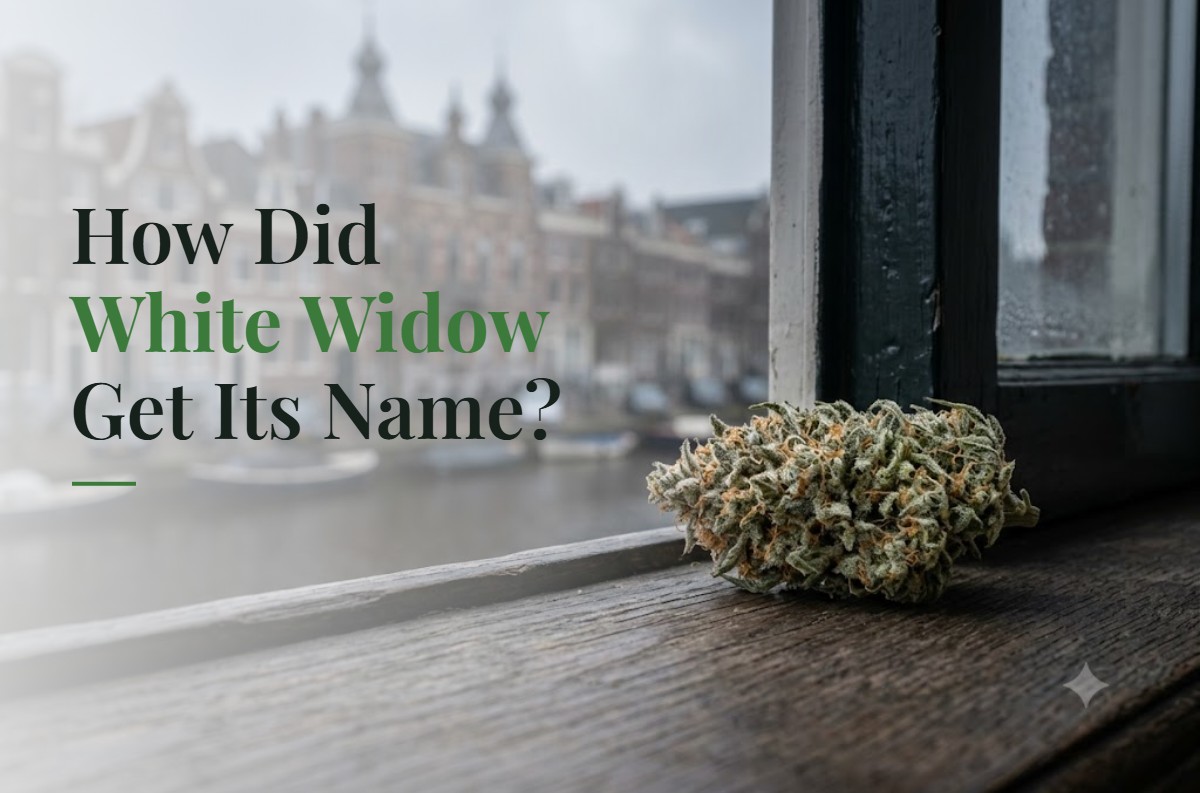
Quick answer: White Widow got its name from the thick white coat of resin glands covering the buds, which looked frosted next to the Skunk and Haze filling Amsterdam coffeeshop menus in the early 1990s. It won a High Times Cannabis Cup in 1995 and the name went global. The "widow" half was never explained by anyone involved, and who actually bred the plant is still argued over.
The frost part is the easy half. Everything after that gets complicated fast.
What does the name White Widow actually describe?
The white is trichome coverage, and it is not marketing language. Cured White Widow flower reads as pale, almost dusty, because the resin glands sit so densely across the bracts and sugar leaves that they mute the green underneath. In 1994 and 1995 that was a real visual shock in Amsterdam. Frosty is normal now. It was not normal then.
The widow half has no source. Nobody at Green House Seeds, nobody at Mr Nice, nobody in the Dutch grower scene has ever pointed to a moment when someone chose that word and said why. The explanations you find online split into two camps: the black widow spider, borrowed for its pale opposite, or a joke about potency putting a partner permanently out of commission. Both are plausible. Neither is documented. We would rather tell you that than pick the prettier one.
For a strain this commercially important, the missing naming record is strange. Compare it to how Gorilla Glue got its name, traceable to specific people and a specific accident, or to Maui Wowie, which is plainly regional slang. Half of White Widow is descriptive. The other half is unaccounted for.
Who actually bred White Widow?
Two accounts compete, and the honest position is that neither has been proven. This is the part the short blog posts skip.
Shantibaba's account
Scott Blakey, who works as Shantibaba, is the name attached to White Widow in most reference sources including Wikipedia. His version: he spent the late 1980s and early 1990s collecting seed across Asia and South America, brought material back from Kerala in southern India, and crossed a Brazilian sativa mother with a South Indian male. He co-founded Green House Seeds with Arjan Roskam in 1994, and the variety went out under that banner.
Arjan Roskam and Ingemar's account
Roskam, who still runs Green House, tells it differently. He credits a Dutch outdoor grower known as Ingemar, later associated with De Sjamaan Seeds, with the underlying work. Ingemar has said publicly that he found seeds in hand-rubbed hashish, worked the line for roughly six years under the name Arnhem's Wonder, and handed the genetics and the name to Roskam. Ingemar has also claimed a cup win in 1989, well before Green House existed.
What both sides agree on
Not much, but the overlap is real: the plant existed in the Netherlands by the mid-1990s, the parentage was Brazilian crossed with South Indian, and Amsterdam coffeeshops were selling it as a clone before any seed company packaged it. Some accounts name Manga Rosa as the Brazilian side. That identification gets repeated a lot and verified never.
Two versions of this story circulate. Neither is documented in a way that settles it, and anyone telling you flatly that one man invented White Widow is choosing a side rather than reporting one.
Why does the 1995 Cannabis Cup matter so much here?
Because it turned a coffeeshop clone into a global product name inside about a year. White Widow is credited with a High Times Cannabis Cup win in Amsterdam in 1995, when the Cup was the only international showcase cannabis had. Winning meant American and European growers heard about you.
One caveat. The exact category of that 1995 win is reported inconsistently across seed bank pages, cup archives and strain databases. The year holds up. The category does not.
Why is there a Black Widow as well?
Because the partnership broke. Shantibaba sold his interest in Green House Seeds around 1998, after what he has described as a deteriorating relationship with his Dutch partner. He went on to found Mr Nice Seedbank with the writer and former smuggler Howard Marks and the breeder Nevil Schoenmaker.
He could not take the strain names with him, so he renamed them. The line he considered the original White Widow came out as Black Widow, and several other varieties he had worked on got new labels for the same reason. Two respected seed banks have now spent nearly thirty years selling what each calls the authentic version of the same plant.
What did White Widow go on to produce?
More of the modern market than most people realize. Once the cutting circulated widely, breeders used it as a resin donor on almost anything, because it passed on trichome density and a short flowering time reliably.
| Hybrid | Cross | Attributed to | Notes |
|---|---|---|---|
| Black Widow | The original White Widow line, renamed | Mr Nice Seedbank | Same claimed genetics, new label after the 1998 split |
| White Russian | White Widow x AK-47 | Serious Seeds | Credited with a 1996 High Times Cannabis Cup first place in the Bio category |
| Great White Shark | White Widow x Super Skunk | Green House Seeds | Green House lists the genetics as Super Skunk, Brazilian and South Indian; cup wins reported in 1997 |
| White Rhino | White Widow x a North American indica | Green House Seeds | The other parent is described vaguely in every source we found |
| Blue Widow | White Widow x Blueberry | Multiple breeders | Also sold as Berry White and other names |
| Moby Dick | White Widow x Haze | Multiple breeders | The Haze side connects it to a much older sativa family |
That last row is the interesting one. Moby Dick pulls White Widow into the Haze family, which traces back to imported equatorial genetics and overlaps with our primer on landrace strains. White Widow is a hinge between the old imported material and the hybrid market that followed.
Is the White Widow on a Washington shelf related to the 1990s plant?
Often not. Strain names have never carried trademark protection in cannabis, so any producer can label a jar White Widow with no obligation to prove ancestry. The original was a clone passed hand to hand in Amsterdam. Everything sold as seed since is a recreation, made by different people from different stock.
The research supports the suspicion. A 2019 study by Anna Schwabe and Mitchell McGlaughlin, published in the Journal of Cannabis Research, genotyped samples collected under identical strain names from dispensaries and found that plants sharing a name were frequently genetically distinct from each other. Names are not lineage. They are labels.
Washington adds another layer. The market here is closed under the Washington State Liquor and Cannabis Board, tracked from seed to shelf, and nothing crosses a state line legally. Every White Widow you can buy in Seattle was grown here from genetics that reached Washington producers years ago. Some of those cuts are excellent. None of them arrived from a coffeeshop last month. Our guide on how to spot fake cannabis products covers the wider problem.
What does White Widow smell and feel like?
Sharp pepper and earth first, usually, with a sour lift behind it and a faint pine edge. It is not a candy strain, and the dessert hybrids have made that profile feel old-fashioned, which is unfair to it. Structure runs dense and chunky, with resin visible on the outside of the cola rather than only inside the nug.
Reported effects lean balanced and alert rather than sedating, which is why it gets filed as a middle-of-the-road daytime option. That is a tendency, not a rule. Effects vary by person, dose and the specific chemovar in the jar, and the hybrid label tells you less than you would hope, as our breakdown of what the sativa and indica labels actually tell you explains. If you are considering cannabis for a health reason, talk to a healthcare provider who knows your history.
How we handle it across the counter
When someone asks for White Widow in West Seattle, our Cannabis Guides do not argue pedigree. We turn the jar around and read the terpene panel, because that is the part that predicts your afternoon. A White Widow heavy on myrcene and caryophyllene feels different from one carrying more pinene and terpinolene, whatever the label claims about heritage.
Then we check the packaged date. Trichome-heavy flower loses its aroma with age like anything else, and a strain famous for resin is a strain worth buying fresh. Our explainer on what terpenes actually do goes further into reading those numbers.
Ask which farm grew it. A producer running the same cut year after year is telling you something a strain name cannot.
Frequently asked questions
How did White Widow get its name?
The white is literal. The buds carry such heavy trichome coverage that dried flower looks dusted with frost, and against the Skunk and Haze on Amsterdam menus in the early 1990s that was genuinely unusual. The widow half has no documented explanation. Every version you read, from black widow spider to knockout potency, is a guess made after the fact by people who were not in the room.
Who created the White Widow strain?
Genuinely disputed. Shantibaba, born Scott Blakey, says he made the cross from a Brazilian sativa mother and a South Indian male out of Kerala, releasing it through Green House Seeds, which he co-founded with Arjan Roskam in 1994. Roskam credits a Dutch grower known as Ingemar with the earlier work. Neither claim has been settled by documentation, and both parties have repeated their version for decades.
What are White Widow's parent strains?
The cross is almost always described as a Brazilian sativa crossed with a South Indian indica, with the Indian side traced to Kerala. The specific Brazilian variety is sometimes named as Manga Rosa, but that is reported rather than proven. No original breeding records were ever published, which is normal for genetics developed while the work was still illegal.
Did White Widow win the Cannabis Cup?
Yes. White Widow is credited with a High Times Cannabis Cup win in Amsterdam in 1995, and that result is what carried the name out of the Netherlands. The exact category is reported inconsistently across seed bank pages and cup archives, so the year is solid and the category detail is worth holding loosely.
What is the difference between White Widow and Black Widow?
Shantibaba sold his stake in Green House Seeds around 1998 and later founded Mr Nice Seedbank with Howard Marks and Nevil Schoenmaker. He renamed several varieties he had worked on, and the line he considered the true original White Widow went out as Black Widow. Same claimed genetics, different label, different company, and an argument that has never fully cooled.
Is the White Widow sold today the same plant from the 1990s?
Usually not. The original circulated as a clone in Dutch coffeeshops, and strain names carry no trademark protection, so any grower can use the name. A 2019 study by Anna Schwabe and Mitchell McGlaughlin in the Journal of Cannabis Research found that samples sold under a single strain name were often genetically distinct from one another.
Why does White Widow show up in so many other strains?
Because it passed on resin production and a manageable flowering time more reliably than most of its contemporaries. Breeders used it as a donor across the late 1990s and 2000s, producing White Russian, Great White Shark, White Rhino, Blue Widow and Moby Dick among many others. A large share of the frosty hybrids on shelves now have it somewhere in the background.
White Widow has been on menus longer than most Washington shoppers have been legally able to buy cannabis, and it earned that shelf space without ever settling who made it. Have a look at the current West Seattle flower menu or the Redmond flower menu to see who is running it this month, then ask a Guide for the terpene numbers.
Origins Cannabis is a licensed Washington retailer serving adults 21 and over in Redmond and West Seattle. Nothing here is medical advice. If you are using cannabis for a health reason, talk to a healthcare provider who knows your history.