
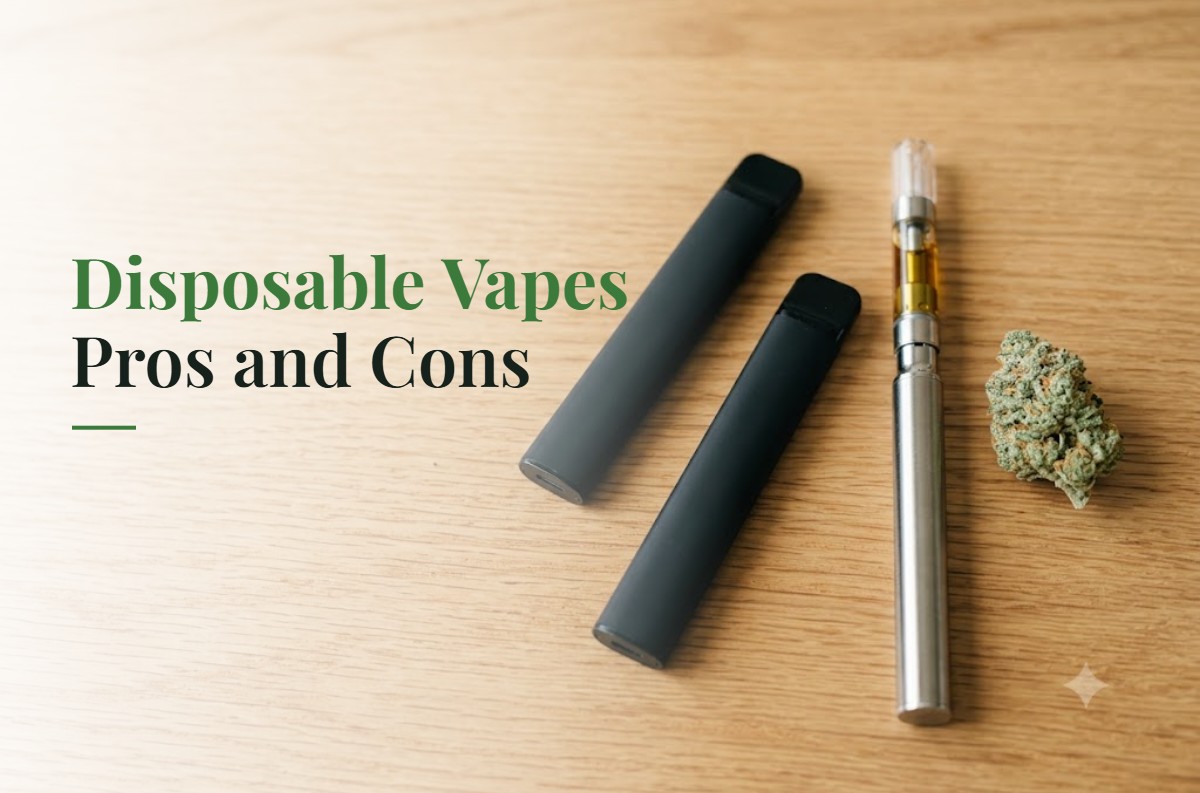
Quick answer: Disposable vapes win on convenience and lose on cost, waste and control. A 1 gram unit runs $25 to $45 on a Washington menu, the priciest way to buy that oil, and every device throws away a working lithium-ion battery. They earn their place for travel, a first try, one evening or a gift. For anything regular, a refillable 510 setup or flower is the better buy.
That is the argument. Below is the evidence, including the parts that do not flatter a format we sell plenty of. The mechanics are covered in how disposable vapes work. This one is the buying decision.
Are disposable vapes worth the money?
Not for regular use. Put a producer's 1 gram cartridge beside that same producer's 1 gram disposable on our shelf and the disposable is usually five to ten dollars more, because you buy a battery and a coil with the oil every time. A gram a month means paying that premium twelve times a year. A 510 battery is $15 to $30 once and lasts years.
Flower is a different order of magnitude: a mid-shelf eighth around $28 is roughly $8 a gram, and Washington menu prices move constantly, so treat that as a ballpark.
Now the caveat most cost comparisons skip: a gram is not a dose. Distillate commonly tests north of 80 percent THC while good flower sits in the 20s, so a gram of oil carries three or four times the cannabinoid load. Adjusted for that, vapes are not the rip off the raw number suggests. Disposables remain the priciest route to that oil. Our piece on why some cannabis costs more has the rest.
Disposable vs 510 cartridge vs flower: which should you buy?
| Disposable vape | 510 cartridge | Flower | |
|---|---|---|---|
| Cost per gram | $25 to $45, hardware every time | $20 to $40, plus a one time $15 to $30 battery | About $8 mid shelf |
| Convenience | Highest. Open and draw | High, once you own a battery | Lowest. Grinding and papers |
| Waste per gram | A whole lithium battery, coil and housing | An empty glass and metal cartridge | Plant material and packaging |
| Flavor ceiling | Fixed voltage, unknown coil, usually distillate | Adjustable voltage, live resin and rosin | Highest, and you smell it first |
| Best for | Travel, first try, gifting | Weekly or daily use, flavor, cost | Home use, best value |
Why is throwing away a lithium battery every gram a problem?
Because the battery still works. The cell inside a disposable is rated for hundreds of charge cycles, gets one, then goes in a bin with the coil, the magnets and the plastic. That is the design, not a defect.
Washington's Department of Ecology says this does not belong in household trash. Never put vape waste in the garbage, never burn it, never pour it down a drain. Cannabis vape waste at 10 percent THC or above designates as state only dangerous waste, and separated lithium-ion batteries can be handled as universal waste.
Then the practical wall. King County takes nicotine vape devices at three fixed hazardous waste sites, North Seattle, South Seattle and Factoria, ten per visit. It does not take cannabis ones at all.
That gap is documented. In March 2024 a licensed Washington producer petitioned the Washington State Liquor and Cannabis Board to ban single use disposable cannabis vapes with non-removable lithium-ion batteries. The Board denied it on May 22, 2024, members Ollie Garrett and Jim Vollendroff concluding that environmental health sits outside the agency's authority, which under RCW 69.50.342 reaches components posing a risk to public health or youth access. It suggested working with Ecology and the Department of Health on recycling information instead.
So: keep spent devices in a box, ask us what options exist, and never put one in curbside recycling, where lithium cells start fires in trucks and sorting plants.
Was the 2019 EVALI outbreak about legal dispensary vapes?
Overwhelmingly no, and the specifics matter more here than anywhere else in this article. In late 2019 the CDC tracked an outbreak it named EVALI, e-cigarette or vaping product use associated lung injury. The final tally, as of February 18, 2020, was 2,807 hospitalized cases or deaths, 68 of them fatal.
The CDC identified vitamin E acetate as strongly linked. It turned up in the lung fluid of 48 of 51 patients tested and in none of the healthy comparison group. It is a cheap oily thickener that made diluted THC oil look full, which is exactly why unlicensed operators cutting product used it.
The sourcing data is the part people forget. Among EVALI patients who used THC products and said where they got them, 78 percent named informal sources only: friends, family, dealers, online sellers. Only 16 percent named licensed retail only.
Washington moved fast. The State Board of Health banned sale and distribution of vapor products containing vitamin E acetate effective November 20, 2019. The WSLCB filed an emergency ingredient disclosure rule on October 16, 2019 and made every processor licensee file a disclosure form by December 1, 2019. That now sits in WAC 314-55-1055 and covers solvents, additives, preservatives, thickening agents and terpenes.
None of that makes inhalation risk free. It makes the supply chain accountable, a narrower claim. Health questions belong with a healthcare provider, not a retail counter.
What does a licensed Washington vape have that an unlicensed one does not?
A test result, a disclosed ingredient list and a traceable producer. Under WAC 314-55-102, solvent-based concentrates clear cannabinoid, residual solvent, mycotoxin and pesticide testing before the oil reaches a cartridge, and pesticide testing became mandatory after the WSLCB adopted rules in 2022. The rules also set metals limits for arsenic, cadmium, lead and mercury.
Those requirements are not uniform across every product category and testing tier, and DOH compliant medical products under chapter 246-70 WAC carry an extra layer, so ask whether a producer tests metals voluntarily. A pen from a friend of a friend has none of this. Our guide to spotting fake cannabis products shows what counterfeit packaging looks like.
When is a disposable genuinely the right choice?
Four situations, all real. Travel inside Washington, where you would rather not pack a battery, a charger and a cartridge that leaks in a warm bag. A single evening out, where losing a $30 device stings less than an $80 setup. A first try, at 0.3 or 0.5 grams rather than a full gram. And gifting, since it is the only vape format that works out of the box. A fifth: if you use cannabis rarely, a cartridge can degrade before you finish it.
One hard line on travel: Washington's market is a closed system. Do not carry licensed product across a state line, do not take it to an airport, and take Idaho seriously.
When should you skip it?
If you vape weekly or more, buy a 510 battery. If flavor is the point, buy a live resin or rosin cartridge and run it low, because a fixed voltage coil flattens terpenes and most disposables hold distillate with botanical terpenes added back in. Our explainer on what terpenes actually do covers why, and FECO and RSO sit at the far end of processing.
And if the e-waste bothers you, which is a reasonable position, buy flower.
What should you check on the label before buying?
Oil weight, not just the price
0.3, 0.5 and 1 gram units look identical on a shelf. The per gram maths hides here.
Extract type
Distillate is cheap, neutral and strong. Live resin and rosin cost more and taste like the plant. If the label will not say, that is information too.
Whether it recharges
A USB-C port on a 1 gram disposable is close to essential. A unit that dies with oil inside is the worst outcome available.
The producer and the test date
Named producers who repeat cultivars year to year are worth paying for. Our piece on who actually grew your weed shows how to read that off a package.
The strain label, skeptically
Sativa and indica on a vape tell you less than the terpene profile does. More on that in what the sativa and indica labels actually tell you.
What we actually tell people at the counter
In West Seattle and Redmond the answer turns on how often you plan to use it. Someone buying for a wedding weekend gets a half gram disposable. Someone who vapes most evenings gets talked into a battery and a cartridge, which costs more today and less by March. Nobody is told the format is bad, because for the right use it is the correct product.
Ask the oil weight, ask whether it recharges, and ask the return policy if the coil fails. Hardware failure is the complaint we hear most.
Frequently asked questions
Are disposable vapes cheaper than cartridges?
Up front, sometimes. Over time, almost never. A disposable bundles the hardware into every purchase, so you pay for a battery and a coil with each gram of oil. The same producer's 510 cartridge usually costs a few dollars less, and the battery is a one time $15 to $30 you keep.
Are disposable vapes safe?
Inhaling anything carries risk, and nobody should tell you otherwise. What changed after 2019 is regulation. Washington's State Board of Health banned vitamin E acetate in vapor products effective November 20, 2019, and the WSLCB requires an ingredient disclosure from processors. The 2019 EVALI outbreak was tied overwhelmingly to informally sourced THC products. Take health questions to a provider.
How do you dispose of a cannabis vape in Seattle?
Awkwardly, is the honest answer. Washington's Department of Ecology says vape waste should never go in the trash, be burned, or be poured down a drain, and King County's hazardous waste sites take nicotine devices but not cannabis ones. Ask whether a producer runs a take back program, and never put a lithium battery in curbside recycling.
Can you recharge a disposable vape?
Many current ones, yes. Most 1 gram disposables sold in Washington carry a USB-C port, because otherwise the battery dies before the oil runs out. Cheaper units are single charge only, and those get thrown away half full. Check for a charging port before you buy.
How long does a 1 gram disposable last?
It depends on draw length and how hard the device hits, so treat any figure as rough. Around 200 to 300 short pulls per gram is a working estimate. For an occasional user that is weeks. For someone using it all day it can be under a week.
Are disposable vapes good for beginners?
They are the easiest starting point, a genuine advantage. No battery to buy, no threading, no voltage settings. The trade off is that concentrate oil is far stronger than flower, so take one short pull and wait ten minutes. A 0.3 or 0.5 gram unit is the better first buy.
Picking one up
If a disposable is the right answer this week, the West Seattle vape menu and Redmond vape menu list oil weights and producers, so run the maths before you arrive. If the cost section talked you into flower, the flower menu is there too.
Tell whoever helps you how often you plan to use it. That moves the recommendation more than anything else.
Origins Cannabis is a licensed Washington retailer serving adults 21 and over in Redmond and West Seattle. Nothing here is medical advice. If you are using cannabis for a health reason, talk to a healthcare provider who knows your history.