
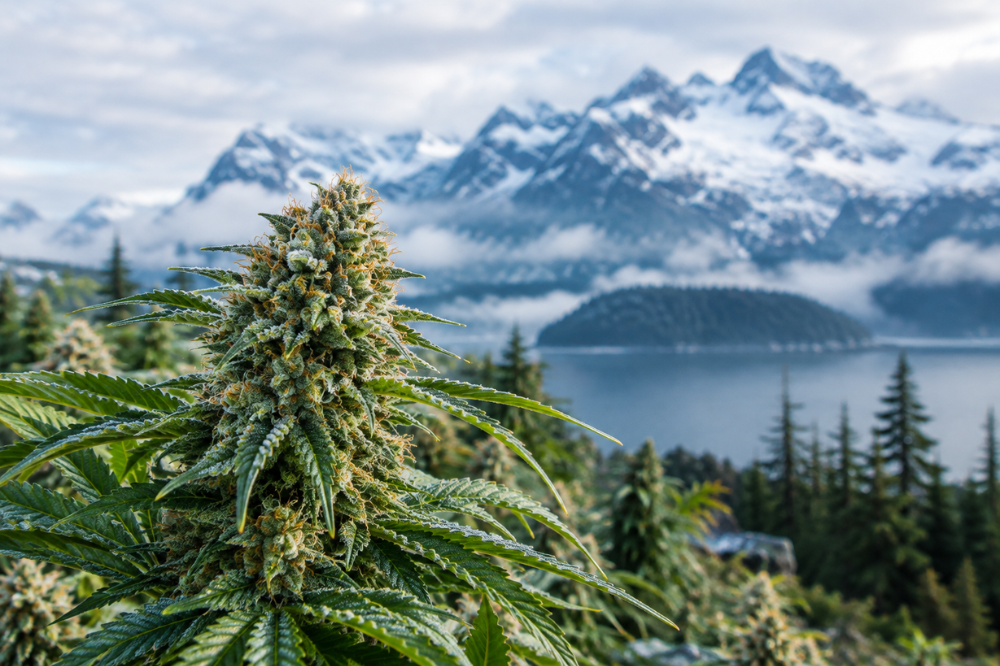
Quick answer: Alaskan Thunder Fuck got its name from the Matanuska Valley, farm country about 35 miles north of Anchorage, where it was first called Matanuska Thunder Fuck. High Times listed "Matanuska Valley (strong)" in September 1974, and by January 1975 it was quoting the full name, censored, at 70 dollars an ounce. The place gave it the first word. The rest was slang for how hard it hit.
That answer takes fifteen seconds. The better question is why a farming valley at 61 degrees north produced a famous strain at all.
Was it originally called Matanuska Thunder Fuck?
Yes, and that is the older name. The Matanuska-Susitna Valley covers Palmer, Wasilla, Big Lake, Sutton, Houston, Willow and Talkeetna, and the flower was named for the area, not one town. Shortened to MTF, it circulated in Alaska before anyone outside the state had heard of it.
The swap to "Alaskan" came later, once the name reached the Lower 48 and most buyers had no idea what a Matanuska was. When that happened is not documented, so a precise year is a guess. You will also see Matanuska Tundra, which is a retrofit rather than an older name. It is what you print when you cannot print the real one.
Why does the Matanuska Valley grow anything at all?
Because the light is extreme, the soil is glacial and the season is short. This is the valley behind the record cabbages at the Alaska State Fair in Palmer, and the 1935 Matanuska Colony resettled 203 Midwest farming families here under the New Deal because the ground was worth farming.
The light is close to absurd
At Palmer's latitude, roughly 61.6 degrees north, the longest day runs about 19 and a half hours, and late July still gives you more than 18. A plant in vegetative growth under that much light puts on structure fast.
The dark arrives too late
That same latitude is the problem. Day length does not drop to twelve hours until near the autumn equinox in late September, and photoperiod cannabis needs shortening light to flower. So an outdoor plant starts flowering right as the frost arrives. Growers answered that by moving indoors under controlled light, or selecting hard for anything early.
Cold nights
Nights stay cool through the valley's summer even when days are warm. Cool nights in late flower are linked to stronger anthocyanin expression, the purple you sometimes see, and growers believe they help hold terpenes. That second part is consensus, not settled science.
Why did Alaska have an open cannabis culture when nowhere else did?
Because of a 1975 court decision that made the state a legal outlier for forty years. In May 1975, in Ravin v. State, 537 P.2d 494, the Alaska Supreme Court held that the state constitution's privacy clause protects an adult possessing a small amount of marijuana at home for personal use.
Read that carefully, because it gets overstated constantly. Ravin did not legalize cannabis, and it did not permit sale or commercial growing. It made small home cultivation far lower risk than in Washington, Oregon or California at the time, so growers could keep plants, compare them, name them and pass seed around. The law then went back and forth for four decades.
| Year | What happened | What it meant for growers |
|---|---|---|
| 1975 | Alaska Supreme Court decides Ravin v. State | Adult home possession gets state constitutional protection |
| 1982 | Legislature decriminalizes four ounces at home, one in public | Ravin written into statute |
| 1990 | Ballot Measure 2 passes with 54.3 percent | Simple possession recriminalized, up to 90 days in jail |
| 2003 | Noy v. State, Alaska Court of Appeals | Struck down for under four ounces at home |
| 2006 | Legislature tries again | Under an ounce made a misdemeanor, litigation follows |
| 2014 | Ballot Measure 2 passes with 53.2 percent | Adult use legal from February 24, 2015 |
| 2016 | First licensed store opens in Valdez, October 29 | A regulated retail market at last |
The 1990 reversal matters. Fifteen years of openness ended, growers went quiet, and the record of who bred what got thinner rather than better. By the time Alaska had legal stores, the people who would have known were in their seventies.
Is the Northern California and Russian ruderalis story true?
Almost certainly not. The version repeated everywhere is that ATF began as a Northern California sativa crossed with a Russian ruderalis, later crossed again with Afghani. No source names a breeder, a year or a farm. It sits in strain databases and gets copied outward.
Two things make it look weak. Ruderalis is a low-THC, day-neutral plant identified in Siberia in 1924, and deliberate ruderalis breeding for autoflowering only became common after Lowryder was released in 2003, three decades after ATF had its name. Crossing it in during the 1970s would more likely have cost potency than added it. The story reads like a later invention to explain how anything finished that far north.
| Claim you will see repeated | Where it comes from | How well it holds up |
|---|---|---|
| Northern California sativa crossed with Russian ruderalis | Strain databases, no breeder or year named | Weak, and the timeline works against it |
| Later crossed with Afghani for resin | The same databases | Unsourced, but plausible on timing |
| The original was Afghan crossed with Pakistani | Ron Bass, a Matanuska Valley grower, from a preserved cutting DNA tested at Phylos Bioscience in 2019 | Attributable, but it describes one surviving plant |
| It came from Big Lake, Sutton, Palmer or Wasilla | Old-timers interviewed by Anchorage Daily News, 2017 | All four get named. Nobody agrees |
| It was never one strain, just a name for good Alaska flower | Growers quoted in the same reporting | The most defensible version |
That last row is the honest conclusion. Several versions circulate, none is documented, and the likeliest truth is that a handful of valley growers each used the name for their own best plant.
Why did the name become a marketing problem?
Because you cannot put it on most of the internet. Menu software, search ads, social platforms and some payment processors filter profanity, so the product ships as ATF, Alaskan Thunder, or the full name with the last word starred out. Leafly lists it under three names at once for that reason.
So the strain is famous and hard to sell by name. Search volume splits across half a dozen spellings, and a shelf tag often says something other than what the producer registered. Compare the trademark fight behind Gorilla Glue and the switch to GG4, where a legal threat rather than a filter forced a rename. Geography names age better. Maui Wowie and Acapulco Gold still work on a menu fifty years on. ATF has to be abbreviated to survive.
Is the ATF on Washington shelves the real thing?
No, and any store telling you otherwise is selling you a story. Almost everything sold as Alaskan Thunder Fuck today is a recreation, bred to land near the described profile rather than descended from a preserved Matanuska cutting.
There is a structural reason too. Washington runs a closed market under the Washington State Liquor and Cannabis Board, so every gram sold here was grown here by a licensed producer and tracked from seed to shelf. Even a genuine Alaskan cut would have entered Washington genetics years ago.
That does not make the flower bad. It makes the label a statement of intent, not a certificate of descent, which is how to read most strain names on a menu.
What does it actually smell and feel like?
Pine and lemon peel first, usually, with a damp forest floor note underneath and often a skunk or diesel edge. Some examples carry a cold menthol lift. On a lab panel that tracks with pinene and limonene.
Reported effects skew alert and talkative rather than heavy, which is why it gets shelved as a daytime option. The sativa tag is a poor predictor of that, and our breakdown of what the sativa and indica labels actually tell you explains why the terpene panel reads better. Start with what terpenes actually do.
Asking for it at our counters
ATF is not a fixture on Washington menus. It appears when a producer runs it, sells through, and vanishes for months. Our Cannabis Guides in Redmond and West Seattle will tell you whether the jar in front of you is a well-grown pine-and-citrus cultivar carrying the name, or just the name. Ask for the terpene numbers and the packaged date first.
If it is out of stock, ask what else is running high on pinene. That is what people are chasing anyway. Our primer on landrace strains covers how regional populations get lost, and the Haze family explainer covers the other half of the 1970s genetics story.
Frequently asked questions
How did Alaskan Thunder Fuck get its name?
It was named for the Matanuska Valley, about 35 miles north of Anchorage, where it was first called Matanuska Thunder Fuck. The second half was crude slang for how hard it hit, and High Times was printing versions of it by January 1975. Alaskan replaced Matanuska once the name left the state.
What does ATF stand for?
ATF is the standard abbreviation for Alaskan Thunder Fuck. You will also see MTF for Matanuska Thunder Fuck, the shortened Alaskan Thunder, and versions with the last word starred out. Menu software, ad platforms and some payment processors filter profanity, so the abbreviation often ends up on the shelf tag.
Is Alaskan Thunder Fuck really crossed with Russian ruderalis?
Probably not, and nobody has produced evidence for it. The claim sits in strain databases with no breeder, no year and no source. Ruderalis is a low-THC, day-neutral plant, and deliberate ruderalis breeding only became common after Lowryder was released in 2003, three decades after ATF had its name.
Why did Alaska have an open cannabis culture in the 1970s?
In May 1975, in Ravin v. State, the Alaska Supreme Court held that the state constitution's privacy clause protects an adult possessing a small amount of marijuana at home for personal use. That did not legalize selling it, but it made small home growing far less risky than anywhere else.
Can I buy the original Alaskan Thunder Fuck in Washington?
No. Washington runs a closed market under the Washington State Liquor and Cannabis Board, so every gram sold here was grown here by a licensed producer and tracked from seed to shelf. Nothing crosses a state line legally. Anything labeled ATF here is a Washington-grown plant bred to that profile.
Is Alaskan Thunder Fuck a landrace strain?
No. A landrace population adapts to one place over a long time with little outside input. Cannabis does not grow wild in the Matanuska Valley, so every plant there arrived as imported seed within living memory. ATF is better called a regional heirloom, and possibly not even one variety.
A strain name is a claim, and this one has been making a large one for fifty years on the strength of a valley, a court decision and some flower nobody wrote down properly. That is a reason to judge the jar instead of the label, not a reason to avoid it. Have a look at the current West Seattle flower menu or the Redmond flower menu and see what is running pine-forward this week.
Origins Cannabis is a licensed Washington retailer serving adults 21 and over in Redmond and West Seattle. Nothing here is medical advice. If you are using cannabis for a health reason, talk to a healthcare provider who knows your history.