
Quick answer: Lobster strains are crosses descended from Blue Lobster, a selected cut of the Apples and Bananas x Eye Candy cross that breeder Chris Lynch released as Facade. Maine Trees hunted it, renamed it and took three trophies with it at the East Coast Zalympix in New York in April 2023. Every other lobster cut is younger than that.
So the family is about three years old, which a lot of the writing about it manages not to mention.
What does the term "lobster strain" actually mean?
It means a cross with Blue Lobster on one side of the pedigree. That is the entire definition. There is no botanical grouping here, no chemical marker every lobster cut shares, and nobody deciding what qualifies. A breeder crosses something into Blue Lobster, puts "Lobster" in the name, and the family gets one member bigger.
Which makes it a naming convention that happens to track a real lineage, at least so far. Compare it to a landrace population, where the grouping describes geography and decades of local adaptation. This one describes a single mother plant and about three years of work stacked on top of her.
Two wrinkles are worth knowing. Not every Blue Lobster cross carries the name: Off Gas is Original Diesel crossed with Blue Lobster and has no lobster in its title. And not every lobster is family. Rock Lobster, listed on SeedFinder as an OG Kush x The Ragpicker hybrid from Brothers Ink., is unrelated and older.
Who bred Blue Lobster, and who is Cipher Genetics?
Two parties doing two different jobs. Chris Lynch made the seeds. Maine Trees found the plant in them.
The cross
Lynch is the breeder behind Compound Genetics, the company that put out Apples and Bananas and Gastro Pop, and he now runs Cipher Genetics as chief executive. The cross that produced Blue Lobster was Apples and Bananas x Eye Candy, released under the name Facade. Sources split on which of his companies gets the credit. Leafly's London Lobster entry calls Blue Lobster "the Maine Trees selection of the Compound Genetics cross," while most seed banks and the Maine Trees interviews credit Cipher. Same breeder either way.
The selection
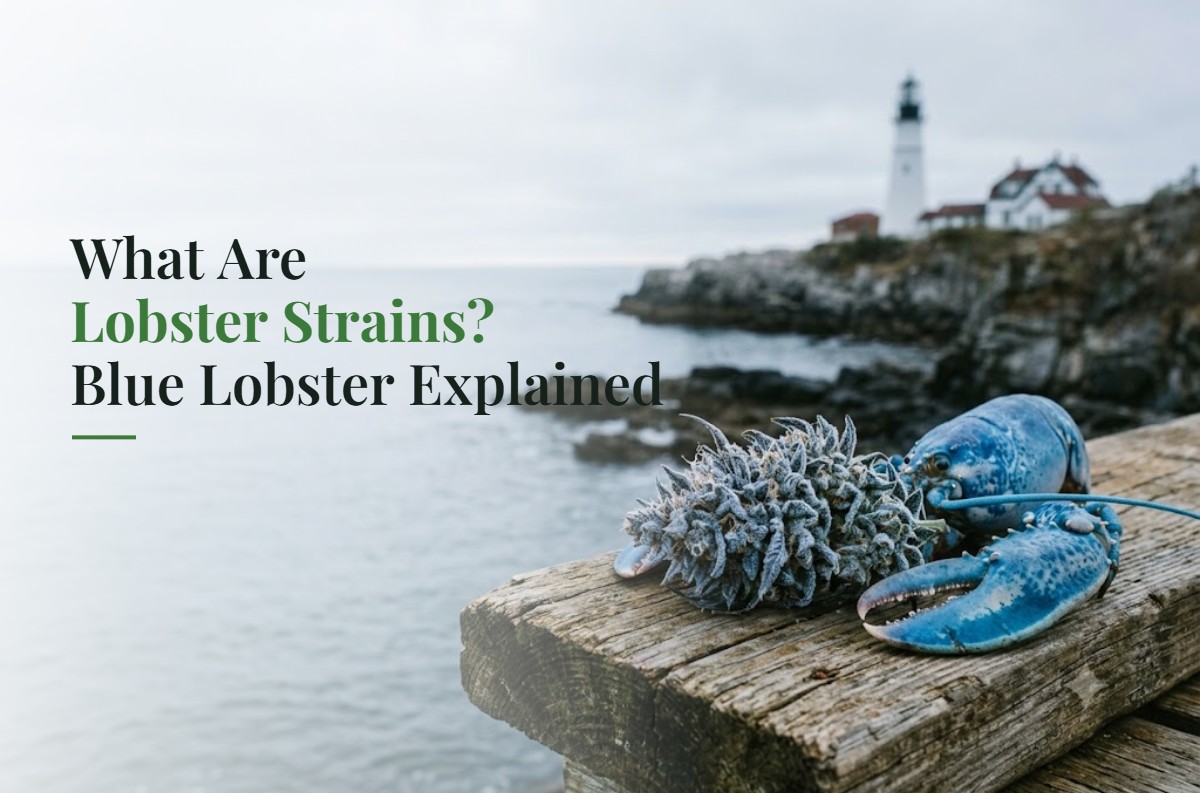
Jesse Jordan and Mike Barris co-founded Maine Trees, and their team ran a phenotype hunt through Facade seed and kept one plant. Jordan told Honeysuckle magazine that the original name was Facade, and described the keeper as an indica-leaning hybrid he puts at roughly 60/40. The rename came from the odds. A naturally blue lobster turns up about once in two million, and the pitch was that a cut this good is about that rare.
That split between breeder and selector matters if you care about who actually grew your weed. The breeder makes the seed. The hunter makes the cultivar. Neither one on their own gets you a Blue Lobster.
What is in Blue Lobster's family tree?
Modern hybrid stacking, going back about a decade. SeedFinder lists Apples and Bananas from Compound Genetics, released in 2019, as Blue Power crossed with Gelatti. Blue Power traces back to Sour Dubble, Blue Moonshine, The White and Master Kush. Gelatti comes out of Gelato and Biscotti. Eye Candy, also from Compound, is listed as Biscotti x The Menthol.
Biscotti therefore sits on both sides of Blue Lobster. That kind of doubling is normal in current American breeding, and it is part of why so much of the modern cookie and gelato pool tastes like a variation on the same theme.
Which cuts are actually in the lobster family?
The confidence column below is about how well the parentage is sourced, not about how good the flower is.
| Cut | Stated cross | Confidence | Where the claim comes from |
|---|---|---|---|
| Blue Lobster | Apples and Bananas x Eye Candy, released as Facade | High | Leafly, multiple seed banks and Maine Trees interviews all agree |
| Grape Lobster | Grape Lyfe 29 x Blue Lobster | High | Listed on Cipher Genetics' own store page |
| Blueberry Lobster | Blueberry x Blue Lobster | High | Cipher catalog plus a Leafly entry dating it to 2024 |
| London Lobster | Brightside Cheese x Blue Lobster | Medium | Leafly entry, dated 2024, credited to Cipher |
| Off Gas | Original Diesel x Blue Lobster | Medium | Leaf Magazines, January 2026, grown in Washington by Lifted Cannabis |
| Black Lobster | Facade VIP x Blue Lobster | Medium | One European seed retailer listing, not confirmed elsewhere |
| Strawberry Lobster | Strawberry Cough x Blue Lobster | Medium-low | AllBud states the cross with no breeder attached |
| Pink Lobster | Cotton Candy Runtz x Blue Lobster | Low | Retailer social posts only |
| Apple Lobster, BBL, Maui Lobster, Purple Lobster | Blue Lobster crosses, second parent not published | Low | Names appear in Cipher's catalog and a European seed-shop writeup, without stated parentage |
| Lobster OG | (Sour Best Shit Ever x Apples and Bananas) x Blue Lobster | Unverified | Circulates on retail blogs, no breeder-side source found |
Nothing in that bottom half is necessarily wrong. It is just unsourced, and unsourced parentage has a way of hardening into fact once enough pages repeat it.
How do you tell a real lobster cross from a borrowed name?
Check whether anyone on the breeder side has published the cross. That single test sorts most of the good listings from the noise.
Strain databases are not reliable here, and one example makes the point. Strainpedia lists Grape Lobster as Grape Ape crossed with something called Lobster Butter, and adds that the original breeder "is not consistently documented in verified public registries." Cipher Genetics sells Grape Lobster on its own site as Grape Lyfe 29 x Blue Lobster. Both pages rank in search. Only one of them is the breeder.
Three habits that hold up:
- Start upstream. Cipher's store, the Maine Trees accounts, and the seed banks that stock them sit above every aggregator and database.
- Check the date. Any lobster cross with a stated release before 2023 is either a different lobster or an error, because Blue Lobster was not known outside Maine before then.
- Ask who grew it. In Washington, the producer's name is on the label. That grower either sourced the cut from somewhere documented or did not.
What does a lobster cut look and smell like?
Blueberry candy and grape sitting on top of gas, with color running from deep green to a dusty periwinkle purple under heavy frost. Leafly lists limonene, myrcene and caryophyllene as the dominant terpenes on Blue Lobster, which fits the citrus and pepper edge under the fruit rather than the berry itself.
Structure is dense and stacked. Our breakdown of colas, buds and nugs covers how flower gets sized and sorted before it reaches you.
The crosses drift from there. Grape Lobster reads grapey and gassy, Strawberry Lobster creamy and berry-forward, Off Gas fuel and citrus haze. Resin coverage is the trait that carries across the line most consistently. Coloration is a distant second, because purple expression depends heavily on how a plant was finished and how cold the room got.
None of that predicts effect. What terpenes actually do and what the indica or sativa label tells you are two separate conversations, and a name settles neither.
Has any of this reached Washington shelves?
Yes, and faster than the age of the family would suggest. Lifted Cannabis, a licensed Washington producer and processor that says its products reach more than 200 retail stores statewide, has run Blue Lobster and worked with Maine Trees on the crosses that Leaf Magazines wrote up in January 2026. Canna Organix, another Washington grower, has had Blue Lobster flower and pre-rolls on menus around Seattle and Everett.
The mechanics are worth stating plainly. No Maine-grown Blue Lobster is legally reaching a Washington store. The state runs a closed system under the Washington State Liquor and Cannabis Board, so every gram on the shelf was grown inside Washington by a licensed producer. What crosses state lines is genetics, as seed or as clone, and then a local farm grows it out. Any lobster cut you buy in Seattle is a Washington expression of a Maine selection of a West Coast breeder's cross.
Asking for one at the counter
Supply on a three-year-old family moves week to week, so this is a question to ask rather than a trip to plan. Our Cannabis Guides in Redmond and West Seattle can tell you which producers are currently running Blue Lobster or one of its crosses, and which jars have terpene numbers that justify the price. You can also scan the West Seattle flower menu or the Redmond flower menu before you come in.
If a label says Lobster and nobody can tell you which cross it is or who grew it, that tells you something about the jar. Popular names get borrowed quickly. Gorilla Glue spent a decade on labels that had no connection to the original cut, and that was a strain with a court record behind it.
Frequently asked questions
What are lobster strains?
Lobster strains are cannabis cultivars with Blue Lobster somewhere in the pedigree, usually as a direct parent. It is a naming convention rather than a botanical category. There is no shared chemical marker every lobster cut hits and no body deciding what qualifies. Blue Lobster itself only became widely known in 2023, so the whole family is a few years old.
Who bred Blue Lobster?
Two parties share the credit. Chris Lynch, the breeder behind Compound Genetics and now chief executive of Cipher Genetics, made the cross of Apples and Bananas x Eye Candy and released it as Facade. Jesse Jordan and Mike Barris of Maine Trees hunted that seed line, kept one plant and renamed it Blue Lobster.
Why is it called Blue Lobster?
Rarity. A naturally blue lobster shows up roughly once in two million, and Maine Trees used that as the pitch for a phenotype they considered a once-in-a-hunt keeper. The Maine connection helps. The original breeder name was Facade, which is accurate and much less memorable.
Did Blue Lobster win Leafly Strain of the Year?
No. It was one of five nominees for Leafly Strain of the Year 2025, alongside Gush Mints, Dulce De Uva, Sour Diesel and Hash Burger. Hash Burger won. Blue Lobster did take three trophies at the East Coast Zalympix in New York in April 2023, though sources disagree on which third category it placed in.
What does Blue Lobster taste like?
Blueberry candy and grape over a gassy base, with citrus and stone fruit in some descriptions. Leafly lists limonene, myrcene and caryophyllene as the dominant terpenes. Reviewers consistently mention that the flavor shifts through a session rather than sitting on one note. Expression varies by grower, so treat any description as a range.
Can you buy lobster strains in Washington?
Yes, though availability moves week to week. Lifted Cannabis, a licensed Washington producer and processor, has run Blue Lobster and several crosses with Maine Trees, and Canna Organix has had Blue Lobster flower and pre-rolls on Seattle-area menus. Everything sold here was grown here, since Washington runs a closed system under the WSLCB.
Are all strains with Lobster in the name related?
No. Rock Lobster, an OG Kush x The Ragpicker hybrid credited to Brothers Ink. on SeedFinder, has nothing to do with Blue Lobster and predates it. The reverse also happens: Off Gas is Original Diesel crossed with Blue Lobster and carries no lobster in its name. The word on the label is not the pedigree.
Origins Cannabis is a licensed Washington retailer serving adults 21 and over in Redmond and West Seattle. Nothing here is medical advice. If you are using cannabis for a health reason, talk to a healthcare provider who knows your history.