
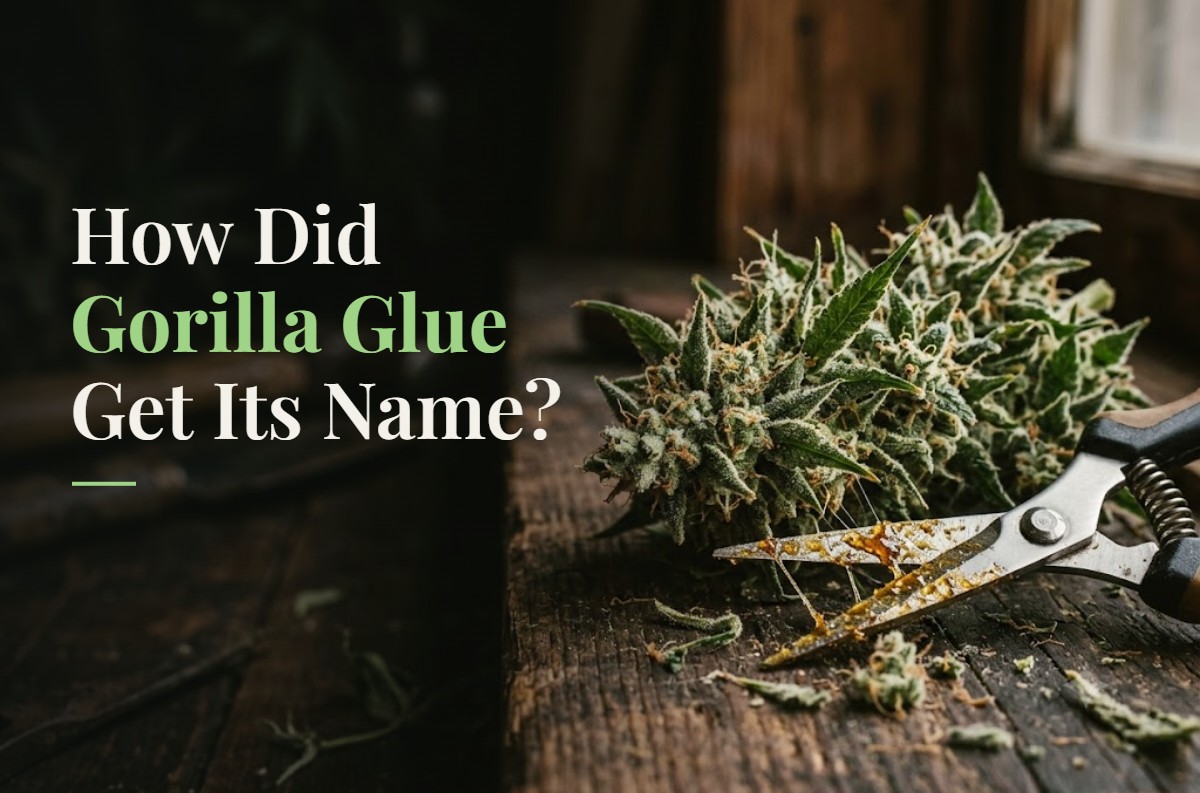
Quick answer: Gorilla Glue got its name from resin. The plant was so sticky that it gummed trimming scissors shut and stuck to the breeders' hands, and one of them said it was like Gorilla Glue. That was around 2010 in a hobbyist grow room. The name spread, the Gorilla Glue Company sued in March 2017, and the settlement forced the rename to GG4 and Original Glue.
Almost every famous strain name is folklore. This one has a federal court docket, two named breeders, dated cup wins, and a settlement with a compliance deadline in it. Best documented naming story in cannabis, and the messiest one on a shelf.
Where did the name Gorilla Glue actually come from?
From trimming. The trichome coverage was heavy enough that scissors seized up mid-cut and resin transferred to skin, and somebody made the obvious comparison to the adhesive.
Two versions of that moment circulate, close enough that both are probably true of different days. In one, the breeder working as Joesy Whales found his scissors and fingers glued together during harvest. In the other, told publicly by co-founder Ross Johnson, a colleague looked at Johnson's hands and said the stuff was stuck like Gorilla Glue. Nobody involved has ever claimed the name was a marketing decision, and the timeline backs that up. A joke between growers first, a brand about three years later.
The two men are Don Peabody, who breeds as Joesy Whales, and Ross Johnson, who breeds as Lone Watie. Both aliases come from the 1976 Clint Eastwood western The Outlaw Josey Wales, in which Lone Watie is the Cherokee character played by Chief Dan George. Outlaw names, forum handles, clones traded by mail. That is the register this started in.
What accident actually created GG4?
A stressed plant threw intersex flowers and pollinated the room. That is the whole origin, and the breeders have never dressed it up as anything else.
The room held Chem's Sister, Sour Dubb and Chocolate Diesel, all elite clones circulating among growers on forums like ICMag at the time. When one plant hermaphrodited, pollen went everywhere it could reach. A hermaphrodite in a flowering room is a bad day. Every seeded bud is a downgraded bud, and the standard response is to cull and write off the run. These two kept the seeds instead.
Why nobody can pin down the year
Published accounts put the pollination anywhere from 2009 to 2013. Some say 2011, some say 2010, some just say around 2009. The strain went public and started winning competitions in 2014, which anchors the late end. The early end is somebody's memory of a grow room, recorded years afterward. A confident single year on a menu card is a guess wearing a suit.
Why did phenotype number four become the keeper?
Because it was the stickiest and the strongest, and because it grew well enough for other people to reproduce it. Those seeds gave several distinct females, the breeders numbered them in sequence, and number four out-resined the rest.
Phenotype numbering is ordinary breeding, not mystique. Pop a batch of seeds, grow them out, number them, keep whichever one earns it. The rest usually vanish. Two of these did not. GG1 was selected as its own release, later sold as Sister Glue, and GG5 or New Glue came afterward as a deliberate cross of GG1 back to GG4. GG2 and GG3 have effectively disappeared, which is the normal fate of a numbered pheno.
Why did the Gorilla Glue Company sue over a plant?
Because trademark law more or less obligates them to. The Gorilla Glue Company, based in Cincinnati, filed a trademark infringement suit against GG Strains LLC in the United States District Court for the Southern District of Ohio in March 2017, arguing that cannabis sold as Gorilla Glue traded on its mark and its gorilla imagery. A holder who watches an unlicensed use spread nationally and does nothing risks weakening the mark. Not a moral position on cannabis.
The two sides settled in September 2017, and the terms were specific. GG Strains agreed to stop using the name, drop all gorilla imagery and similar marks, and finish the transition by September 19, 2018, with licensees given a further 90 days. The company could say "formerly known as" during the changeover and keep a history page explaining it. The gorillaglue4.com domain went over by January 1, 2020. No damages were paid. Johnson later told trade press the rebrand cost GG Strains around $250,000 anyway.
What the case changed about cannabis branding
It set the ceiling. A cannabis brand cannot win a fight against a candy, food or hardware trademark, because it usually cannot own a federal trademark of its own.
Cannabis remains federally illegal, and the United States Patent and Trademark Office will not register a mark for goods that violate federal law. The plant-touching business fights with one hand behind its back while the consumer brand holds a full federal registration. Glue was the loud early demonstration, and the pattern held: Wm. Wrigley Jr. Company sued the makers of Zkittlez in 2021 and settled in 2023 on similar lines.
The lesson on offer was to stop naming products after things you can buy at a checkout counter. Some of the industry took it. Walk a menu and you will still find cookies, cereal, candy and cake.
| Name on the menu | What it means | Worth knowing |
|---|---|---|
| Gorilla Glue | The original pre-2018 name | Legally retired, never left everyday speech |
| GG4 | Post-settlement name for phenotype four | This is the famous one |
| Original Glue | The other official name for that plant | Same cut, different label |
| Glue | Shop shorthand, almost always GG4 | Ask if the jar does not say |
| GG1 or Sister Glue | A different keeper, same seed batch | Related, not identical, often brighter |
| GG5 or New Glue | GG1 crossed back to GG4, released later | A deliberate cross, not a found pheno |
| Gorilla Glue #4 | Labeling that ignores the settlement | Usually GG4, sometimes just sloppy |
| Gorilla Breath, Gorilla Cookies | Unrelated crosses using the word | Not GG Strains genetics unless stated |
What does GG4 actually smell like?
Pepper and fuel, not fruit. The panel is usually led by caryophyllene with limonene and myrcene behind it, and that combination smells nothing like the sweet profiles dominating shelves right now.
Caryophyllene is the black pepper and clove note, dry and warm with a woody edge. It is the one terpene that also lives in your kitchen pepper grinder, so people recognize it instantly once it is named. Limonene is citrus rind rather than citrus juice: sharp, bitter, closer to grapefruit pith than lemonade. Lay those over the sour, solvent, faintly chocolate base Chocolate Diesel contributes and you have GG4. Sour up front, peppery at the back of the throat, coffee and diesel underneath.
Grind a nug and the pepper gets much louder. Fastest check there is on whether a jar labeled Glue is behaving like Glue, and our guide to what terpenes actually do explains why the panel predicts more than the THC number does. The buds run dense and pale under heavy frost, and they are a standing example of a fat cola versus a nug.
Why this story is the exception
Most strain names have no paper trail. White Widow's naming is still argued over by people who were in Amsterdam at the time. The geographic names on landrace and heirloom populations came from smugglers and slang, not from breeders filing anything. Even a shelf term as odd as lobster strains has murky beginnings.
Glue is the opposite. Named people, known parent clones, a documented accident, first place at the Michigan and Los Angeles Cannabis Cups in 2014, the High Times Jamaican World Cup in 2015, a lawsuit with a case number, a settlement with a calendar deadline. Hold the next origin story you hear to that standard and see how little survives.
What we tell people about Glue at the counter
That the name on the jar is the least reliable thing about it. Plenty of Washington producers grow something they call GG4, and the range between them is wide. Some run the authentic cut tracing back to those clones. Others grow seed lines bred to approximate it, and a good seed-grown Glue can beat a badly grown clone.
Washington runs a closed market under the Washington State Liquor and Cannabis Board, so every gram was grown here and tracked to the shelf. The paperwork is real even when the name is loose. Our Cannabis Guides at Redmond and West Seattle can tell you who has Glue in right now and what the caryophyllene number looks like. If a jar smells sweet and candied and the label says Original Glue, trust your nose. Our notes on spotting products that are not what the label claims go further.
Frequently asked questions
How did Gorilla Glue get its name?
It was named for resin. The plant produced so much sticky trichome coverage that it gummed up trimming scissors and stuck to the breeders' hands, and one of them compared it to Gorilla Glue adhesive. The nickname travelled with the clones and was in wide use among growers long before anybody thought seriously about branding.
Why is Gorilla Glue now called GG4 or Original Glue?
The Gorilla Glue Company, the Ohio adhesive maker, sued GG Strains for trademark infringement in federal court in March 2017, and the two sides settled that September. GG Strains agreed to drop the name and all gorilla imagery by September 19, 2018, and rebranded its cuts as GG4 or Original Glue, GG1 or Sister Glue, and GG5 or New Glue.
What are the parents of GG4?
Chem's Sister, Sour Dubb and Chocolate Diesel. The cross was not planned. A stressed plant threw intersex flowers and pollinated its neighbors, and the resulting seeds were saved rather than thrown out. GG4 is one of the numbered females that came out of germinating that accident.
What is the difference between GG1, GG4 and GG5?
GG1, sold as Sister Glue, and GG4, sold as Original Glue, were both selected from the same accidental seed batch and share the same three grandparents. GG5, or New Glue, came later and was bred deliberately by crossing GG1 with GG4. GG4 won the cups, and it is what almost every shelf means when it just says Glue.
What does GG4 smell like?
Sour and heavy, with black pepper and clove from caryophyllene, a sharp citrus rind lift from limonene, and a coffee, chocolate and solvent note underneath from the Chocolate Diesel side. It reads more like a spice drawer next to an open fuel can than like fruit. Grinding a nug makes the pepper much louder.
Is the GG4 sold in Washington the real cut?
Sometimes. Washington is a closed system under the Washington State Liquor and Cannabis Board, so anything on a shelf here was grown here, and the genetics arrived as clones or seed years ago. Some Washington farms run the authentic GG4 cut and some run a seed-grown approximation under the same name. The terpene panel and the producer tell you more than the label does.
Worth a look on the shelf
Glue turns up in Washington regularly, in flower, in pre-rolls and especially in concentrates, where all that resin is the point. It is heavy, so go slower than the THC number suggests. If you use cannabis for a health reason, talk to a healthcare provider who knows your history.
Check the West Seattle flower menu or the Redmond flower menu, then ask for the terp panel. If the caryophyllene is there and the jar smells like pepper and fuel, the label is doing its job for once.
Origins Cannabis is a licensed Washington retailer serving adults 21 and over in Redmond and West Seattle. Nothing here is medical advice. If you are using cannabis for a health reason, talk to a healthcare provider who knows your history.